
The new year, or new millennium if you accept that, started with our traditional New Year's Day Cioppino dinner at a friends. Thirty plus of us enjoyed the camaraderie and great food.
With no holiday decorations to worry about taking down, we stayed around the Bay Area and joined friends for bridge and pinochle before leaving for King City and the Winter Festival Square Dance we have enjoyed for many years. Had a great time and continued southward from there to Morro Bay for a few days in hopes of catching some of the migrating California gray whales. It was our first glimpse (after 20 years in California) of the "Gibraltar of the Pacific." In fact, the RV Park we were at was just a stone's throw from it. But, alas, the rains began and we hit the road.
Next Ventura - on the beach we walked and rode our new bikes. Weather forecast said the rains were coming, so we headed for Valencia where we stocked up on oranges and grapefruits and enjoyed the sunshine. Our generator took sick, so we took it to Van Nuys where they very promptly fixed the problem and we were back on the road.
ThePalm Springs area was our next stop. We were there the week of the Bob Hope Classic. We needed to put away some of our "winter type clothes" and dig out those shorter and cooler ones, so we dug around in the bowels of Camelot and took care of that task. Ray's birthday weekend we attended the Palm Springs Follies. Now in its 9th year, this Ziegfield-like production is a great vaudeville show. All performers are over fifty years old, and one high kicking dancer was eighty-two!
Since we were so close to the "world's largest swap-meet," we decided to stop in Quartzsite, Arizona to see what all the talk is about. It is truly amazing! Thousands of RV's parked everywhere in the desert. Tents and all kinds of products for sale--used, antiques, junk, gems, and anything else you can think of. Fascinating once-in-a-lifetime stop. Our second day there, the wind kicked up and started whipping desert sand around, so we pointed our home toward Lake Havasu City and the London Bridge. The weather was great, so we stayed a few extra days.
The last weekend of January we went to Surprise, Arizona for a visit with Ray's brother and wife. Superbowl Sunday we enjoyed the hospitality of a niece and her husband in Phoenix.
PHOENIX, ARIZONA
Enjoyed visiting, playing pinochle, bowling, Mexican train dominoes and several side trips with Rich and Roswitha while in Sun City Grande--Surprise. We went to an Indian Hoop Dancing tournament, a Chocolate Festival and a Senior Fitness Fiesta. We parked at their home for a few days, then went to an RV resort with all the amenities of Sun City. Great place. We enjoyed the visit very much!
We had the windows on Camelot tinted with a "limo" tint wherever legal and lighter tints on the other windows. We also had the new roof vent covers installed, so wind and rain are no longer a concern if the vents are open. Pretty neat stuff!
From the Phoenix area we went to Tucson to visit Ray's mother and sister. More visiting, eating, and card playing. Next stop--Mesa and some square dancing.
Lots of friends here in Mesa - folks we had no idea spent time here. It is really like old home week. We have been dancing C1 and A2 to Mike Sikorsky and Randy Dougherty and one evening with Bill Haynes calling. Everyone has been great. Friends from Los Altos have chauffeured us several times. We enjoyed the "famous" Organ Stop Pizza followed by Cold Stone Ice Cream. Organ Stop Pizza features a 1927 Wurlitzer Theater Organ built for the Denver Theater which has been restored and added to. The entire building was built around the organ to show all of its components in the best fashion. The organists are accomplished in pop, broadway jazz and classical music. A most enjoyable evening -- and the pizza was pretty good, too!
On a Sunday after church we drove through Apache Junction towards Tortilla Flat (sounds like a bad Western novel, doesn't it?) and stopped at a ghost town which is now a tourist stop and enjoyed the shops, train, horses, characters and wagons, but a dust storm kicked up, and we ran for cover and headed back to Mesa.
This would be an enjoyable place to spend a longer period of time. However, right now we are itching to move on. Speaking of itching, my eyes have been itching and watering since we arrived in Mesa. They were okay in Lake Havasu, Surprise and Tucson, but they are killing me here. I'm taking antihistamines and eye drops like crazy. So, maybe I'm allergic to Mesa.
Ray finally got his multiple flat tires on his new bike fixed (went through three new inner tubes), and he is running me ragged. Five miles is about the best I can do yet, but I'll increase it gradually. He goes without me after we have reached my limit.
KARTCHNER
CAVERNS
A quick overnight stop in Tucson then on to Benson, Arizona where
we arose at 6:00 am to get in line to get tickets to visit Arizona's newest
state park, Kartchner Caverns. This massive living cave just opened
in November 1999. While I was looking up information on the internet,
a TV news report stated the cave tours were sold out until June.
But, undaunted, we went to Benson anyway, and the campground told
us they have 100 tickets available daily. The Visitor Center opens
at 7:30, but people line up about 5:30. So, leaving for the 7-mile
trip to the park at 6 am gave us a number 22. We got tickets for
the 1:00 tour.
Anyway, the caverns were discovered by two cavers in 1974. They kept their secret from the owners of the land until 1978. They then sold the land to the Arizona Park System in 1988. Eleven years later the park opened. It was a massive undertaking. There is a column (stalactites forming downward meeting stalagmites forming upward) that is over five stories high. The rotunda room is the size of a football field. The last time I got up that early to see something was when we were in Australia going to Ayers Rock.
TOMBSTONE, ARIZONA
This mining town was founded in 1877 when silver was discovered. The mines were closed a couple of times and were permanently flooded in 1903. They remain flooded beneath the town today.
The Gunfight at the OK Corral is definitely the town's most infamous piece of history, but many other stories certainly rival it. The number of "ladies of the evening" and gunfighters who actually inhabited this place reads like a who's who of bad western movies.
The Bird Cage Theater is still here with much of the original dust in tact. Lyrics to the song popular in the century, "She's only a bird in a gilded cage..." originated with this theater. Fourteen bird cage crib compartments suspended from the ceiling overhanging the casino and dance hall is where the "ladies of the night" plied their trade. Sixteen gunfights took place there and 140 bullet holes are in the walls and ceilings.
Boot Hill Cemetery (the first with that name) is where the infamous and unknowns are buried beneath piles of rocks. Many tombstones simply read with a name, shot by and a date. One poor guy was hanged by mistake, and his tombstone has an apology for that error on it.
DEMING,
NEW MEXICO
This sleepy town in southwestern New Mexico sounded interesting
enough to make a stopover. It was founded in 1881 an is just south
of Cooke’s Canyon which was one of the three most dangerous places in the
Southwest to travel through between 1850 and 1888. Apache leaders
involved in the various raids, killings and massacres in Cooke’s Canyon
included Mangas Colorado, Cochise, Geronimo, Victorio, Juh, Chato and Nana.
The tales of the various ambushes are the basis for most of the old “Westerns.”
The railroad came to Deming in 1881 along with the Harvey House and civilization. Military bases for state and federal troops affected the town's growth. State parks nearby include Rockhound State Park from whence those interested can remove 20 pounds of rocks per person. How's that for a day's haul?
COLUMBUS,
NEW MEXICO
This tiny border town was the site of a raid by Pancho Villa on
March 9, 1916 which led to the subsequent expedition into Mexico by 10,000
U.S. Army soldiers led by General “Black Jack” Pershing. Pershing
tracked Pancho Villa for 11 months (unsuccessfully) 400 miles into the
Mexican Desert. This was the last U.S. cavalry action and the first
to employ mechanized vehicles. I grew up near a main thoroughfare
in Chicago called Pershing Road and knew only that it was named after some
general, now I know more about him.
In Columbus is Pancho Villa State Park which was the site of Camp Furlong from whence Pershing amassed his forces. One of the most interesting remains at this park is a concrete grease rack. The design is essentially the same as today's, but the trucks and/or tanks drove up onto the concrete rack.
From Columbus you can drive about a mile to a border crossing and walk into Palomas, Mexico. This town seems to exist solely for Americans who go there for prescriptions, dental work and eyeglasses. People came and went very quickly. It is certainly not a tourist town, as shopping was limited, except for the pharmacies, dentists, etc.
Returning from Columbus to Deming, the highway was dotted with rather unkempt homes or ranches, and we noted a rather nice home coming up on the right hand side of the road. It was pueblo style and obviously new. An iron gate led to the driveway with the name clearly stated, “Rancho cost-a-lot.”
ST. CLAIRE'S VINEYARD, DEMING, NEW MEXICO
One of the not to be missed sites in an around Deming is the local
vineyard. We stopped and found the wine tasting clerk (or perhaps
the owner) at a table hand painting the bottles for the winery. There
were desert scenes and congratulatory messages for many occasions available.
All were individually painted and signed. Inside the shelves were
full of the many choices. BUT, the biggest surprise was when a local
came in with two empty wine bottles and they were filled at a tap along
the wall with his choice of wines and recorked with plastic corks.
They are the only place in the U.S. (according to the artist/proprietor)
to do this. She gives instructions to folks as to how to sterilize
their bottles, then for $2.50 they have a new $7.50 bottle of wine.
Not bad, but I doubt it will catch on in the Napa Valley.
LAS
CRUCES, NEW MEXICO
We left Deming enroute to Carlsbad Caverns. Our only choice
is to go through El Paso, TX, and the first place on the road was Las Cruces,
New Mexico. It was Saturday morning and we were told there was a
farmer's market and craft fair every Wednesday and Saturday. The
market was on the covered mall in the downtown area. We found some
artsy/crafty folks mostly as we arrived too late for the farmers.
I did get some beautiful tomatoes though from one woman whose kids were
playing with the remainder of her wares.
This was another lesson to us in learning to adjust our expectations. Having lived first in Chicago and next in California, both very populous areas, we must adjust our thinking and expectations to sparsely populated places like New Mexico. While this little market was a charming quick stop, I am not yet to the point that I would recommend it to most travelers.
EL PASO, TEXAS
We arrived in El Paso in late afternoon but early enough to get
to Saturday Mass. The church was a charming semi-circular building
which was of a design popular in the 60's and 70's, but some distinctly
Catholic features were missing–kneelers and pews. The seating was
in cushioned chairs like you find in extra seating at an auditorium.
Just another of our broadening adventures in religion.
Discovered we had phone service when we were in El Paso, so I got to speak with some of the kids. Left messages for the others. Anyway, we spent the night in El Paso then left on Sunday morning for Carlsbad Caverns.
CARLSBAD
CAVERNS, NEW MEXICO
Ray drove from El Paso through the great flat desert land across
Texas as we headed back to New Mexico. I took over the driving later
in the day and had the pleasure of navigating the narrow winding road when
we arrived at Carlsbad Caverns National Park in the afternoon. We
rode the elevator down to the Big Room and did a quick look-see at the
caverns and but decided to return the next day for the full treatment..
We checked into an RV park at the entrance and took in the scenery.
Early Monday morning we drove back the winding road to the caverns, rented the CD audio tour and started the descent of the Natural Entrance--about 750 feet in one mile. The walk description says. “This trail is steep and the walk strenuous...Not recommended for those with health problems involving the knees, back, heart, or lungs.” What it should say is, “causes health problems involving the knees...” I spent the afternoon icing both knees and feel like future walking will always be a challenge. The bat entrance and the descent were a fascinating trip into the ethereal domains of the cave, so I guess the pain is okay.
After a brief respite, we started the Big Room tour, a two hour walking tour of the caverns which are the size of fourteen football fields. Absolutely incredible! Took lots of photos, some with the night vision features on the digital camera. I can't wait to have a closer look at them.
PECOS,
TEXAS
Drove to Pecos, Texas for the night–the home of the first rodeo.
The Texas wind is rocking Camelot as if it were a tent!
We pulled out of the RV Park and went to the Pecos Museum in town. Interesting building housed in a 19th century hotel complete with a saloon with brass markers indicating where the local gunfighters were killed. Also picked up some western lore that I had never heard before. Stories of both lawmen and outlaws spoke of them wearing metal breastplates (bullet-proof vests). How about that?
Anyway, back to Pecos. By the time we finished our couple of hours in the museum, the wind which had been fairly strong when we entered, was at full gale force. The radio said a local highway was closed due to zero visibility, so we drove (very carefully) back to the RV park from whence we had come. I went into recheck us in, and when I came back to the rig, the wind was blowing so strongly that I had to hold on to the door with both hands to keep it from being damaged. I made it up to the second step when a gust of wind blew me off the steps and a few feet away. The door can be fixed, but I haven't hurt in so many places all at once in years.
The storm continued through the remainder of the afternoon and finally let up about sundown. The Texas brown dust infiltrated through every minuscule opening in our motorhome. Must take off a day to clean, vacuum, wash and shampoo everything.
We sat out the storm then drove on down the road to Abilene on Ash Wednesday. Ray drove, and I creaked around.
ABILENE, TEXAS AREA
We drove past Abilene to a tiny town called Baird. Decided
to clean our home inside and out, so Ray worked on the outside while I
shampooed carpets and dusted and vacuumed everything I could reach.
We were shiny and clean with sparkling windows and mirrors. In the
morning as we were leaving, a storm front was reported on the National
Weather Channel which identified the location as Highway 20 - the road
we were on and were taking toward Fort Worth. C’est la vie!
FORT
WORTH, TEXAS
We rolled our dirty and muddy little home into a small RV park in
the heart of Fort Worth. This was one of the primary stops on the
Chisolm Trail in the late 1800's and was a veritable melange of cowboys,
cattlemen, gamblers, saloons, gambling parlors, shooting galleries and
dance halls.
After checking in we drove over to the city museums nearby. We could have walked, it turned out to be so close. Enjoyed the Kimball Art Museum with its tiny but impressive collection of masterpieces. We also breezed through the Museum Modern Art--20th Century art, not my favorites. A quick tour of the famous, Billy Bob’s, the World’s Largest Honky Tonk. Billy Bob’s is constructed on the site where the livestock were penned after arriving in Fort Worth. It also has an in-house bull ring, a video arcade and 40 bar stations in its nightclub.
On Saturday the traffic was negligible, so we drove to Sundance Square, the downtown district which was once a hideout for the likes of the “Hole-in-the-Wall Gang, Butch Cassidy and the Sundance Kid, and home to Wyatt Earp and Doc Holliday for a while. Fire Station #1 had an historical display of 150 years of Fort Worth History, a concise and informative display which we enjoyed. The impressive Bass Performance Hall was having rehearsals and tours and pricing tickets for an upcoming performance (what, we didn't learn) at $500.00 per seat. The Tarrant County Courthouse was another stop on our downtown excursion.
The small Sid Richardson collection of Western Art featured paintings by Remington and Russell (the only two Western Artists of which I was hitherto aware) and a few others. Some of Remington’s bronzes were on loan from the Amon Carter Museum which was closed for remodeling. We both enjoyed the works in this friendly and compact gallery in downtown Fort Worth.
Next we headed for the historic Fort Worth Stock Yards. It is like a trip to the Old West with modern conveniences. The entire district is teeming with activity. The shops and saloons are to be expected. There is a cattle drive down Exchange Avenue (the main drag) twice daily. Stagecoaches and carriage rides are available but must fight for position among all the trucks. There was a rodeo that night, so as we ambled around town, we came upon a corral where the cowboys were practicing roping calves. It was a mini-rodeo and all free. The announcer told the cowboys which ones were up, gave them their time then moved on to the next. We saw as many teams perform as we have seen at the national rodeo. Of course, it was just one event, but what a kick.
The White Elephant Saloon looked familiar, and a sign in the window said that it becomes C.D.’s for the TV show, Walker. Next we ventured to the Stock Yards Hotel. When we entered this finely restored building, a group of people were milling around the front door. Luggage and packages were everywhere. A young woman was on a cell phone frantically giving instructions to someone to pick up three white corsages. The young woman was attired in a shirt, jeans, a casual jacket and was wearing a fingertip length bridal veil!
DALLAS, TEXAS
Downtown Dallas is glass and class. I loved seeing that huge
glass complex they used to show on TV with all the reflections in it.
I photographed it and when all the photos accompanying these travels become
web pages (yes, I'm going to get it done) you can see it too!
The huge concrete JFK Memorial
is aptly dubbed “the empty tomb.” The concrete enclosure without
a roof is designed to be a place of meditation. Just a block away
is Deely Plaza and the former Texas
Book Depository from which Oswald fired the assassination shots.
The Sixth Floor is a multimedia memorial to JFK’s life and death, centering
heavily on his death and the subsequent events and investigations.
A little depressing but certainly informative. The audio tour was
excellent.
We tried to visit “Old City Park” but it seemed to be under construction, so we didn't stop. We drove to “Fair Park” and went one step beyond the guide books instructions, “It is advisable to visit the park and fairgrounds only during daylight hours. Leave wallets and handbags in a safe place and travel with a partner.” We drove around it at a good clip.
WAXAHACHIE,
TEXAS
A gingerbread Victorian town which boasts 20 percent of the Texas
historical buildings was fun to photograph. I took loads of photos.
The red sandstone Ellis
County Courthouse is one of the most photographed buildings in the
state, so I didn't pass it by. A nice side trip. Overnight in Corsicana
PALESTINE, TEXAS
Driving south I was glancing at the map and noticed we were close
to the town of Palestine where my genealogy records for an uncle of Ray’s
have several question marks. So we backtracked a bit and headed into
town. The only large building we could see was the county courthouse
which had records back 150 years, but no death info for this uncle.
The conclusion was he must have died within the city limits of Palestine,
so we headed to City Hall and quickly located the record. The clerk
didn't know the exact cemetery location, so she made a quick phone call
and was told the Tennison we were seeking, who died 42 years ago, was buried
in the row closest to the street.
Next stop the public library for the newspaper coverage which once again was about a five minute quest. If only all genealogy missing information was this quickly obtained. We went to the cemetery, photographed the grave and then decided to see if we could find the woman who knew the exact grave location. We didn't find her, but Ray spoke with her husband who not only remembered his uncle, but remembered all the details and added some information. We were back on the road in less than two hours. Small towns, ya gotta luv ‘em.
CROCKETT,
TEXAS ON LAKE HOUSTON
Headed down the road from Palestine and decided to stop at Crockett
at a campground that said it was on Lake Houston. Somewhere on the
road, we were transported from Texas to Wisconsin. The landscape
changed from prairie and dust to trees and grass. The campground
was way, way off the highway, but the lake was delightful. Fishermen
apparently searching for bass and some families with kids on spring break
were some of the few patrons at the campground. The lake was dotted
with cottages and mosquitoes. Yes, that is the price you pay for
all that lovely green, so I had to dig in the bowels of the rig for the
insect repellent.
We hung around the lake all morning and into the early afternoon when we decided to head for Livingston, which is the headquarters for Escapees, the RV club for full time RV’ers. We had already stayed at one of their parks and have used their discounts several times, so we decided to take a peek at national headquarters. Quite an operation - large and friendly. Spent the night then got an appointment in Houston to have the satellite dish looked at (can't seem to get it to work). Off again.
Post office, some groceries from a supermarket, a few miscellaneous household items from Wal-Mart, a camcorder tape from Best Buy, a part from Radio Shack, and what happened to the day? Went to the RV dealer and parked in their lot to be taken care of first in the morning. The satellite dish is fine, but there is evidence of an intermittent short in the receiver which may or may not be a problem.
HOUSTON,
TEXAS - WATERWAYS
We decided to head to the eastern side of Houston to the San Jacinto
area, using the maps we took the obvious road to get to our destination.
The narrow two lane road along the waterways had a drop-off on either side
and water on both sides of the road. Traffic ahead of us stopped,
and we had about twelve vehicles in front of us at some barrier.
There was a lot of traffic on the waterway, and we seemed to be waiting
to let a large ship go through. Well, were we ever wrong! The
back up was not for a bridge, as we had imagined, but for a ferry.
Two small ferries were zipping back and forth across a narrow passage hesitating
only to let really large vessels go through. There were absolutely
no signs saying who could or could not proceed, and there was no room to
turn around, so when the ferry arrived, we were directed forward to the
front near the middle of the four lanes. If our front end wasn't
hanging off the flat bed ferry, you couldn't prove it by me. What
a kick! It was just like driving on water. Oh, did I mention
there was no charge?
After taking Camelot for it’s first boat ride, we went to theUSS Texas. This battleship was commissioned in 1914, served in both World Wars, and was given to the state of Texas by the United States of America. One of its 1914 guns launched a shell which was described as having the same capacity as “launching a small compact car over 12 miles.” Quite a ship for almost a century ago.
Next stop was the San Jacinto Battleground and Monument where the destiny of Texas was said to be begun. At this battleground Sam Houston defeated Santa Anna, and this led to the subsequent independence of Texas from Mexico in 1836. It took place about six weeks after the Alamo, so the victory was an inspired one by the Texans. Charleston Heston narrated an excellent historical slide presentation derived from paintings of the battle and its participants. The monument itself is an obelisk topped by a “Texas star” with a reflecting pool in front of it. If it sounds like the Washington monument, that's what we thought, but no mention of any similarity was made anywhere.
When we left, we took the ferry back to the RV Park for the night. More fun at the water park!
HOUSTON, TEXAS - NASA
Drove to the Johnson Space Center and did the NASA tour. We
visited Mission Control and saw an IMAX presentation of the space missions.
In 1973 when we visited Cape Canaveral with the kids I would have loved
to have found such a hands-on presentation of the space program, but it
seemed a lot like Disneyland today. This was the last day of spring
break in the Houston area, so there were plenty of kids present.
GALVESTON,
TEXAS
Drove into Galveston on a warm, muggy day. We parked at a
parking meter (actually two meters) and walked around the historic district
taking photos of the late 19th century buildings. Decided to tour
the tall ship, Elissa.
I just can never pass up a tall ship. She is moored in the busy harbor
of Galveston with offshore oil rigs just a stone's throw away. Quite
a contrast. Next we went to offshore oil
rig that is a museum or education center and learned more than we ever
thought we would know about offshore oil rigs. A film of the 1900
hurricane that devastated Galveston, killed 6000 people and provided the
impetus for building a seawall
that has protected the city from such devastation since then.
When we finished the film a storm was brewing, and we went out to the seawall. Almost had deja vous with the storm and the wind and the door as I was trying to get a photo. People were vacating the beaches as the winds increased and the rain started coming down. A magnificent stormy sea to photograph. The Catholic church that survived the hurricane was having a 5:00 Mass on Saturday as we were departing, so we decided to attend there. The church was gothic style and beautifully kept. When Mass was over we went outside to clear skies and sunshine.
LAKE
CHARLES, LOUISIANA
Drove back through the Houston area to get out of Texas and drove
to Lake Charles, Louisiana. We settled in for the evening and took
care of some paperwork the next morning before setting out sightseeing
in Lake Charles. Three activities on our list included the riverboat
casinos, the Charpentier District and the Shell Beach District.
From the distance a roller coaster like structure turns out to be a bridge spanning Lake Charles. As you enter town the two riverboat casinos on either side beckon you. We answered their call and visited late in the day for a look around. Enjoyed dinner there after getting a 55+ Preferred Member badge, along with a adult sip-it cup.
A lumber boom in the late 1880's brought lumbermen from the north to Lake Charles. Known as “Michigan Men,” these working classcharpentiers (carpenters) built homes to their liking without the aid of architects. When a disastrous fire destroyed much of the sprawling town in 1910, architects were brought in to rebuild. Notably the Southern architects Favrot and Livaudais constructed a Beaux Arts style Courthouse, the old City Hall, and a sprawling red brick Catholic Cathedral of the Immaculate Conception.
From the working class side of town, we drove to the more upscale area which runs along the lakeshore called Shell Beach Drive District. These impressive mansions vary widely in style but exude elegance. Many have the distinction of being continuously lived in, often by the same families for decades. The homes are historical styles and even new structures are sometimes made to look old to fit in the neighborhood character.
LAFAYETTE,
LOUISIANA
On the road between Lake Charles and Lafayette, we were approaching
Welsh, LA. My maiden name is Welsh, and every time I do a search
in a genealogical database for “Welsh,” I come up with scads of hits leading
me to Welsh, LA. So, we decided to detour quickly through this bane
of my internet searches. Nothing spectacular, but at least I know
where it is now.
We drove to the sister city of our old town, Lafayette, California, and found absolutely no similarities. Vermilionville is a “living history museum” which sounded like a great place to learn more about the history of these French farmers from Nova Scotia who became the Cajuns. Acadians (Cajuns) fled from the Vendee region of France and settled in Acadie in Nova Scotia in 1604, but in 1713 the English took control of their land and suggested these French Catholics become loyal to the English Church (sounds like Ireland). Those refusing were deported and some found their way to this area. They fished, hunted and trapped in the waters of the region.
Here in Lafayette the Cajuns lived on the Bayou Vermilion and maintained their distinct ways. Vermilionville has both original (1790) and reconstructed buildings showing life in the 19th century in what is now Lafayette. Workers are dressed in period costumes and give demonstrations of the work that was done here a century ago. A wood carver was carving ducks from trees that are now extinct. Around the turn of the last century the lumber boom resulted in the harvesting of all of a variety of cypress trees, but their stumps survive in the swamps. So, they are allowed to go in and harvest this unique wood to use for their carvings. Cajun musicians played folk music and some folks danced to it. Something else you don't run into very often in the United States were guides who gave their tours in another language. My French is pretty rusty, but it didn't sound like they left anything out.
We stopped at a local grocery store and stocked up on boudin for dinner. Boudin is a local sausage of pork and rice and is referred to as pudding in a casing. It was spicy and delicious; the rice cut the spices enough that it didn't adversely affect me. It was very tasty and quite rich. For tomorrow we have a shrimp stuffed chicken from the Big Easy Meat & Seafood Company. Probably rich! We are at an RV Park and parked in a grove of live oaks. Sounds picturesque, but it is also very close to a busy highway. Life always has its tradeoffs.
AVERY
ISLAND, LOUISIANA
The Tabasco tour is a must on the list of things to do in this part
of Louisiana, so I slathered on sunscreen and insect repellent and got
ready to go. My daily skin regimen consists of baby sunblock #30
reapplied as needed and insect repellent when biting creatures are in view
(99-105% of the time). The Tabasco factory provided an interesting perspective
on this pepper sauce which we all take for granted in our pantries.
A miscellaneous informational item learned was that the pepper pickers
use a petite baton rouge (little red stick) to determine if the peppers
are the proper color for picking. Also printed some recipes from
their computer. Received miniature bottles of Tabasco, so I'll try
the recipes sometime later.
One of the McIlhenny’s (Tabasco family) was a conservationist who transformed part of the island into a Jungle Garden. It is home to once almost extinct. but now thriving egrets, alligators are in the bayous alongside the trails, and one small snake scurried out of my way alongside some blazing azaleas. A few squirrels and turtles resting below the egret nests were the only other wildlife we saw. We weren't saddened by missing the bobcats and a litany of other wildlife purportedly present here. Some other visitors were kind enough to point out the alligator trails in the swampy water to me so I could see where they had been. We saw a few sleeping in the slime of the bayous, but we had been warned not to approach them, so we heeded the warning!
A forest of live oaks draped with Spanish Moss was stunning; each vista more spectacular than the previous one. I couldn't help but think of the Elizabeth Taylor/Montgomery Clift movie, Raintree County. It could have been filmed here. Took lots of photos again.
BATON
ROUGE, LOUISIANA
Highway 10 across the southeastern part of Louisiana is more of
a bridge than a highway. Great expanses of the highway are on raised
concrete pillars spanning the bayous. It goes on this way for miles
and miles. Two lanes in either direction are each separate structures.
The capital city of Baton Rouge is not named for the little red stick used at Tabasco but a refers to the name, large red staff, a 1699 French explorer proclaimed when he saw a tall cypress tree, stripped of its bark and draped with freshly killed animals and marking the boundary between hunting grounds of two Indian tribes. Too much information? Sorry.
Anyway, Baton Rouge became the capital in 1849 and the Old State Capitol is built like a gothic castle one sees all over Europe but never as a state capitol. After the Union Army burned the building, only the exterior stone walls were left standing. It was repaired in 1882 and served as the capitol until 1932. The striking architecture includes a colored glass Cathedral dome, a cast iron staircase, and tales of Huey P. Long the infamous Louisiana governor/senator. A Louisiana Purchase exhibit refreshed my memory on this piece of American history.
Huey Long convinced the powers that be in Louisiana during the depression that a new capitol building would save the state money. This one looks like the Empire State Building. It is the tallest state capitol in the U.S. at 34 floors. The art deco style is very impressive. It was completed in 1932 after only 14 months of construction. In 1935 the building which he conceived was the site of Huey P. Long’s assassination. We felt totally immersed in the politics of Louisiana by the time we finished touring both capitol buildings.
RIVER
ROAD PLANTATIONS
We had to backtrack several miles to visit Nottoway
Plantation, but it was well worth the trip. Built in 1859 this antebellum
wonder. It is the largest plantation home in the South and has been
continually occupied since its completion. The 92 year old woman
who still lives there and runs a gift shop on the ground floor is the granddaughter
of the couple who built Nottoway. She makes lively conversation with
everyone who ventures in there and is thoroughly charming. The home
has been sold twice since she owned it, but each purchase stipulates that
she may live there until her death.
The plantation itself was built with sugar cane money and spared from Union Army destruction because the officer in charge had once been a house guest there, the plantation was the center of a 7,000 acre plantation and had conveniences like gas lamps, indoor bathrooms and an intercom system of bells like those used in European homes. The all white ballroom is used for weddings, and a bride was being photographed in the ballroom and on the grounds when we were there. This majestic home is designated a National Historic Landmark which it richly deserves. It operates thirteen rooms as a bed and breakfast and guests receive an extra key so they can go into the rest of the house after the tours are finished for the day and look around at their leisure. That alone would be worth the price.
Continuing on down the River Road we viewed Oak Alley Plantation with its two rows of live oaks framing the entrance and Laura, a Creole plantation where Americans were introduced to the legend of Br’er Rabbit. Bad roads but well worth the ride.
NEW
ORLEANS, LOUISIANA
We're in the Big Easy and having a ball. Our RV park is near the
river about five miles from the French Quarter. A quick bus ride
and we're in the heart of everything. On our way into town the first
day here we were discussing where to disembark, and the woman in the seat
in front of us turned around to help us out. Turns out she was a
tour guide, so we got the benefit of her expertise. Stopped at the
French Market first then we took the Cemetery Tour praised by Frommer’s
and enjoyed the tales of our Acadian (Cajun) guide reinforcing the information
we had recently learned about the whole France/Nova Scotia/Louisiana exile.
His added comment was to thank the British for deporting his ancestors
or he would be “freezing his butt” off in Nova Scotia with his cousins.
Quite a character!
Anyway, the cemetery tour took us to the Archdiocesan Cemetery known as St. Louis 1, the oldest cemetery in New Orleans. We all know they bury their dead above ground because the area is a swamp and if buried in the ground, the coffins float up when the water table rises. But, the practice of removing the earlier deceased from their coffins and scooping their remains into the basement of the tombs to make room for the more recently deceased was new information for me. However, the modern way of making room for the next guy isn't as romantic, they put grandpa in a plastic bag, label it and then throw him in the cellar of the tomb.
As we moseyed around the French Quarter we heard approaching bagpipes, and suddenly there was full blown parade passing by. Almost fifty photos show the young (and some not so young) women in pastel formals tossing flowers to the spectators as they rode by in antique autos, all the horse and mule drawn carriages in town, and even a fire engine. The parade was the Spring Festival and in addition to the bagpipes there were multiple New Orleans jazz combos marching and many feathered American Indians on horseback.
An early dinner gave us time to attend Saturday evening mass a St. Louis Cathedral, the 200 year old cathedral in the heart of Jackson Square. I could get used to attending Mass at Cathedrals. They are almost regal. Took the bus back to the RV Park with several other people going to campgrounds and made the acquaintance of some folks from Ontario. We exchanged emails and phone numbers for when we visit Canada. With no home, we couldn't respond in kind with an offer for them to visit us.
Sunday we had the time to ride the trolley all the way up St. Charles Avenue and view the mansions along the road. Tulane and Loyola Universities sit side by side on the elegant street. As we made the return route, the trolley filled with tourists, the conductor shouted at cars blocking his way and threatened to destroy the fenders of any vehicle in his path. The tourists got thicker in the trolley, and I felt like I was back on a crowded streetcar in my youth in Chicago or San Francisco. Loved it.
Down to the Riverwalk, late seafood lunch then a light sprinkle finished up our Big Easy visit.
MISCELLANEOUS NOTES
I have never before traveled through the small towns of the Southwest
and now the South and continue to be amazed at the large number of mobile
homes (manufactured homes) everywhere. There are sales lots for new
manufactured housing lined up along the major roads in every town from
Southern California an on into Florida. Entire towns, albeit usually
small ones, consist solely of manufactured housing. Housing on Indian
reservations was primarily older trailer homes, with a scattering of newer
ones.
Choosing landscaping as a profession in much of the southwest would probably not be wise. Very few middle class homes seem to have any kind of landscaping in the harsh dry climate of Arizona, New Mexico and Texas. The more affluent areas like Sun City Grande, Sun City West and Scottsdale have well maintained desert landscaping, but other areas seem to have given up on the difficult climate.
Living in California for the last twenty years, people often inquired how we live with the threat of earthquakes. Folks in this part of the world have large blue highway signs with white arrows designating them hurricane evacuation routes. When we have driven on them, the traffic has been relatively light, but I bet it isn't when the weather forecast includes that hurricane.
Near Pensacola, Florida for a few days enjoying some kickback time, doing laundry and income taxes we shared the campground with a group of musicians having daily jam sessions in the recreation hall. They are meeting twice a day with spectators having fun with what I suspect are really their practice sessions.
We finally signed up for our satellite service, and I'm delighted with the digital audio channels. All my CD’s of Broadway Musicals, vocalists and instrumentals are right there on the satellite. I can play the CD’s while moving and listen to the satellite when parked. Can't beat that! Also, since our original access card was defective and had to be replaced, they gave us the $90 complete package free for the first month. Not only am I amazed that anyone would pay $90 for TV, I cannot believe they would keep it considering what is available. There are lots of channels and lots of movies, sports, and heaven knows how much news, but not $90 worth of it–even if you watched it 24 hours a day!
Gotta go read my new book. When touring New Orleans, we heard the tale of the legalized prostitution district called Storyville, and the guide mentioned there was a book written about it. When shopping the “flea market” in the French Market, we came across it for $1.00, so I'm now going to learn everything about the red light district at the turn of the last century.
MILTON, FLORIDA
We stayed longer than originally intended in Milton, Florida. I read a couple of books, worked on computer and camera, and caught up on the laundry. Did some web pages (not uploaded to internet yet), and generally didn't do much on a day to day basis. Ray worked on the taxes, watched sports on the hundred of sports channels available on the new satellite, worked on the taxes, watched sports... Well, you get the picture. We loafed. Decided to hit the road on Sunday and caught Mass in Crestview, Florida at a little church with a young “fire and brimstone” priest. The town was a nice upper middle class type neighborhood very similar to Deerfield where we used to live in Illinois with big rambling homes on wide lots with lots of green grass. No desert landscaping here.
SARASOTA, FLORIDA
We're at a resort RV park in Bradenton, Florida with its very own
lake. It is picturesque but is in the middle of the park with the
campsites running around it, so getting to the office which is right across
the lake is a long walk with a computer.
On my list of wanna-sees in Sarasota was the Circus Museum, so we headed for the Ringling Complex. Toured the extensive art gallery of pieces collected by John Ringling then headed to the Circus Museum. This was my first opportunity to use my new wide angle lens for the digital camcorder which we found at this great camera shop in New Orleans while looking for a $20 filter. Anyway, the titanium lens is great, and I got a little carried away, as I seem to have quite a few photos. The Ringling Mansion which was under renovation had a beautiful rose garden, and I photographed every possible rose.
We drove down Longboat Key, my first trip on a “key.” I'm not sure what the exact definition of a key is, as my limited computer dictionary just says, “see island.” Looking at the maps of the various keys, my guess would be it is a long, skinny island close to a larger land mass, but that is just my guess. Anyway, the keys are lovely. They have beaches on both sides of their little land mass and the breezes are delightful.
The next day we had lunch with Selina's other grandparents at their condo in Sarasota. We enjoyed the company, the lunch and their delightful view of the beach.
FORT MYERS, FLORIDA
Tucked away in this resort area are nineteen acres on the Calooshatchee
River where Thomas Edison
and Henry Ford were neighbors and friends. Back in 1885 Edison and
a business partner visited Fort Myers and within 24 hours purchased the
riverfront property and began construction of two identical homes. Two
years after a visit to Fort Myers, Henry Ford purchased an adjacent estate
in 1916.
We all know many of Edison’s inventions, but I was amazed to learn he held over 1,000 patents, and is the only person to date who filed a patent for sixty-five consecutive years. He was still inventing when he died in his mid-80's in 1931. Henry Ford worked on his automobiles at his estate until they went in to mass production in Dearborn. Edison’s laboratory was moved to Michigan in 1925, but in 1927 another laboratory for rubber experiments is begun.
In addition to all this information and history, there is a huge botanical garden of rare and sometimes weird plants. Edison used many of them in experiments, but mostly he was just interested in the variety. The second largest Banyon tree in the world is on Edison’s estate–the first largest is in India and the third largest we saw several years ago on Maui. It was an interesting and informative day well spent.
EVERGLADES
CITY, FLORIDA
Today we did it all. At least a lot of it. I have wanted
to go to the everglades on previous visits to Florida, but we were either
too far away, didn't have enough time, or it was god-awful hot. Well,
the weather today was warm but breezy, and we set off for the everglades.
A triple header tour offered us a pontoon boat ride, an airboat trip, and
a tram ride.
The airboat alone was an experience. Propelled by a huge fan the boat skims along the top of the water at very rapid speeds. We were in the mangrove wilderness which looked identical to me to the one we visited in Australia a few years back. We watched a mother osprey feeding her youngsters in their nest. A few alligators, some ringtail raccoons and a lot of water made for an enjoyable trip.
Next we joined about a dozen pelicans and three folks from Switzerland on the pontoon boat. The captains mate had cut up fish to feed the pelicans which promptly brought them from the roof of the pontoon boat to the railings. My terror of birds, like of the parakeet Ray’s family had when we first met, rose to new heights when the pelicans joined us and spread their wings appreciatively when they were fed the fish. Wisely, although we were on board first, we had not chosen the front seats which were not under the awning/roof.
A short distance into the trip the captain stopped the motor and let us drift in the river where manatees are abundant. We were rewarded with four of them practically within arms length. I have been trying to get a glimpse of them in the wild since we arrived where they are. These endangered species sea mammals are fascinating, and I really wanted a glimpse of them. It was a real treat.
Next we visited a different family of ring-tailed raccoons who rushed to the approaching pontoon boat. These swamp dwellers pull small black crabs from their homes in the mud to eat them, but they rushed to the boat for the doggie bones which were thrown to them.
A lack of alligators on the river didn't stop the captain's assistant from bringing out Spike, his pet year and a half old alligator. The burly Swiss gentleman opted to hold Spike when encouraged. Spike's owner asked the Swiss repeatedly to hold Spike less vigorously, but the request wasn't in his list of familiar phrases, and his grip on Spike did not lessen. Thus agitated Spike proceeded to urinate in a wide area all over the Swiss lady's purse. Once again, I was so glad we weren't in the front seat.
The third leg of our adventure was called a tram ride, but it is really a big truck that resembles the troop trucks used in World War II but with seats. A plastic awning suspended by roll bar like pipes the length of the vehicle protects you from the sun. The waterway we followed in the tram was abundant in wildlife. Fish so numerous you could reach out and catch them, and so many alligators of all sizes that we lost count. A few turtles and some turkey vultures rounded out our ride, with the driver apologizing the whole time about not seeing any deer. We could care less as deer were such destructive visitors to our property in Lafayette.
We returned to our luxury RV resort in Naples, Florida with a feeling that our time was well spent.
NAPLES, CONTINUED
We are still in Naples, Florida enjoying the RV Resort Park.
Similar to other "snowbird" parks, this one is lushly landscaped with palm
trees, gorgeous flowers in bloom and decorative rock formations.
There is a golf course, tennis courts, two swimming pools, and two lakes
stocked with fish. Two clubhouses are lovely facilities with clubrooms
and an auditorium. As I am writing this I am in the clubhouse nearest
our site in a side room which is being remodeled. There is one cabinet
and a chair and a modem hookup. In the adjacent main auditorium a
9-piece band is rehearsing. They are quite good, and the vocalist
who sang one of my all time favorites (Puff the Magic Dragon) was excellent.
The place is emptying out now as many of the Canadians leave by April 1st, and Americans trek homeward in time to file income taxes and/or when the snow is melting.
We attended Mass in Naples at a huge church where there were so many cars in the multiple parking lots that we thought there must be a parish festival or something else going on. But no, when we entered church we were faced with a huge congregation topped by gray and shining heads. The seats were filled, and the average age must have been about 72-75. We were definitely in the youngest age group. I'll bet the church is almost empty within a month. The priest was a Lithuanian from Joliet, Illinois (originally from Lithuania) seeking contributions for post communist Lithuania.
We were so busy sightseeing and enjoying our fancy resort that we hadn't paid much attention to the local news. I was vaguely aware of hearing some fire reported on the newscast, but since we really didn't know the local geography we didn't connect. Early Monday morning I noticed some smoke (or perhaps fog) in the distance over the lake. The news reports increased about the fires to the east, and about 4:00am I was awakened by smoke wafting through the window. The next morning as we were leaving, the entire area was engulfed in smoke which was drifting toward Marco Island to the other side of us. Once on the road we got closer to the black smoke and were happy to be on our way to Key West. But first, we had to stop to drop my computer off for some repairs in Miami. It was sick again.
KEY WEST
We drove the fascinating Highway 1 through the Keys over multiple
bridges and to our spot on the ocean in Key West. We backed Camelot
up to within four feet of the water, leaving just enough room to put up
chairs for lounging or reading or nothing. Ray met his old gang while
I relaxed on the water reading books and watching movies on the satellite.
Can't ever remember having time to waste like that.
After a couple of days of this routine, Ray decided his zest for sitting around in bars and drinking was waning, so we went sightseeing in Key West. Aside from the myriad number of bars in Key West, there were some sights to see. Everyone possibly knows Key West is the southernmost place in the U.S. The town was first settled in 1823 and became a naval base to stop piracy in 1826 and an army post in 1831. Mid nineteenth century Key West prospered from the salvage business. In the late 19th century the USS Maine sailed the 90 miles from Key West to Havana where she blew up and ignited the Spanish-American War.
Construction on Fort Zachary Taylor began the year Florida became a state, 1845. It was named after the president when he died in 1850. Yellow fever, hurricanes and lack of materials slowed construction but by the time of the Civil War it was complete enough to house canons with a range of three miles, and the fort remained in Union hands throughout the Civil War. Once completed it boasted such modern items as sanitary facilities flushed by the tide and a desalination plant to produce drinking water. Multiple changes took place over the years to keep the fort as modern as the times demanded, but alas deterioration was inevitable, and the state of Florida is now undergoing a large restoration to the fort. The fort is in the midst of the Naval Station at Key West and you walk down a path with barbed wire fences and gun toting guards on duty at entrances. Interesting experience.
Early in the 20th century a wealthy industrialist decided to build a railroad from Miami to Key West. After thirty million dollars, three hurricanes, 700 lives lost, and eight years the railroad was completed in 1912 and brought tourists to this Caribbean town. Flagler’s railroad was washed to sea in a devastating hurricane on Labor Day 1935. International travel was seated in Key West also. We had lunch in the building that was the first office of Pan Am. In 1927 Pan Am flew to Havana in the first international scheduled flight.
Artists and writers have found Key West an ideal place to let their creative juices flow. Here Tennessee Williams wrote The Glass Menagerie, Night of the Iguana, and The Rose Tattoo. Robert Frost spent time here also. But the most famous and longest in residence was Ernest Hemingway who made Key West his home while married to wife number 2 from 1930 to 1940. Here he created a study accessible only by a catwalk from the main house where he did much of his best writing like Death in the Afternoon, Green Hills of Africa, To Have and Have Not, The Snows of Kilimanjaro, and For Whom the Bell Tolls, among others.
His wife built the first swimming pool in Key West in the late 1930's at a cost of $20,000. It was a salt water pool. The grounds are home to cats who are direct descendants of Hemingway’s nearly 50 cats, some of whom are “the famed six toed cats.” Papa Hemingway was a rough old codger whose idiosyncratic life is idealized by the tour guides, but the visit was interesting and informative.
During World War II German U-boats sunk 109 merchant ships in eight months off the Florida coast. The Harry S. Truman Little White House is really the commandant's quarters at Key West Naval Station. Harry spent only 175 days of his presidency in Key West but it is a shrine to those glory days. Restored to it’s 1948 splendor of the Truman era, a complete history of the Missouri haberdasher's life is covered during the tour, albeit with a few obvious errors. Pointing to a sofa and a phonograph, the tour guide related how the teenager Margaret sat there with her father listening to recordings. Margaret was actually 22 years old when Harry first came to Key West in 1946 – do the math -- she's 76 now. Aside from such inaccuracies, the tour was enjoyable, but indoor photographs weren't allowed, so nothing will show up on a web page except some exterior shots.
GATOR PARK - MIAMI, FLORIDA
We left Key West and returned to the Miami area to await the completion
of my computer fix. Naturally, a delay occurred and we spent more
time than intended at a campground aptly named “Gator Park.” We chose
it because of its proximity to the Gateway location on the outskirts of
Miami, not for its picturesque menagerie. This roadside campground
featured airboat rides into the everglades for tourists unwilling to go
farther in to the real everglades. They had a zoolike collection
of web-footed chickens, alligators, peacocks, ducks, and I'm not sure what
else. The most irritating were the peacocks who did their screeching
on a nightly basis.
Got the computer and hit the road. Since the Easter weekend is coming up, and our family is a continent away, we decided to head toward Orlando where distractions abound to keep our attention. Stopped overnight on Lake Okechobee north of Miami after driving through a little traveled area that resembled Midwestern farm lands complete with cattle grazing and plowed fields. Lots of orange groves, but oranges are pricey!
KISSIMMEE - ORLANDO AREA
We stopped at a little RV park a surprisingly short distance from
the Disney attractions, less than 5 miles from the entrance.
Of course, once you get to Disney property, you drive for miles and miles.
We decided to revisit Epcot (our last visit was in 1989) and to spend an
additional day going to Disney's MGM Studios. Epcot had added a few
attractions with hands-on kid magnets. The Living Seas exhibit had
a rescued manatee in captivity
which enabled us to get a look at her in clearer water than those we saw
in the wild. They were in water tinted by the roots of the black
mangrove tree which dyes the water a tea color.
My recollection of Epcot was an adult oriented park featuring international “visits.” The World Showcase of countries hadn't changed, and I remember now why I enjoyed the visits to these countries--unlike the real countries, they have drinking fountains, lots of clean, spacious, free bathrooms stocked with toilet paper, and the restaurants serve ice water. We enjoyed soaring above the Chateau Chambord in Impressions of France, and we didn't have to wait in line to take the elevator up the Eiffel Tower. O Canada's circlevision reminded us of the splendor of Quebec City and gave us some insight in to what we will be visiting on our trip this summer. China, Mexico, Norway, Germany, Italy, Morocco and the United Kingdom beckoned us with romantic visions to schedule return visits and see more of these great places.
The United States, however, focused on history rather than geography with Mark Twain and Ben Franklin taking us on a flag waving ride through our country's beginnings right up to the new millennium using stirring photos and toe tapping music. My neck was sore from all the circlevision theaters, and the raucous trip to Israel with a 3-D film and moving seats on moving platforms was a neat trick. The parades and fireworks alone are worth the trip.
MGM Studios was enjoyable because Disney does know how to put on a show! Their “Readers Digest condensed” versions of animated and Broadway productions were condensed only in length not quality, as the presentations were excellent. We had seen Beauty and the Beast on Broadway, and this Florida version featured characters who resembled the animated characters as opposed to those on Broadway, but the rest was pure Broadway. Hadn't seen any version of The Hunchback of Notre Dame, but this was certainly worth the price of admission. The ingenious movements of stage characters like pigeons and gargoyles was great! The Little Mermaid show was just okay.
We loved the Muppet 3-D Vision show, but not as much as the woman in front of me. She ducked and screamed each time something jumped on her nose or came flying at her. Sounds Dangerous, a sound show in a darkened theater while you wear headphones, makes you realize how the sense of hearing gives us so much information. Took photos on the backlot stage set of New York - we'll show them to you later and tell you New York was empty when we visited.
But, the most fascinating thing about a trip to any Disney facility is the way they move people. They entertain you and move you a couple of inches every now and then just to make you think you are progressing. While at NASA in Houston we lamented the sheer drudgery or waiting in line and watching the inefficiency of getting people onto trams, and truly wished the NASA crews had been trained by Disney!
ST.
AUGUSTINE, FLORIDA
From the make-believe of Disney to the history that lies a little
over 100 miles away. We quickly decided the best way to see this
435 year old city would be via sightseeing tram. For $12 each we
got a three day ticket on a tram that stopped all over town. We parked
at one of their lots, took the tram and got off whenever we wanted and
reboarded at will. Trams ran every 15 minutes. Such a deal!
The city of St. Augustine was founded 40 years before Jamestown and 55 years before the Pilgrims landed on Plymouth Rock. The town boasts of the oldest house, the oldest wooden school house, the oldest store, and The history goes something like this:
***1000 - 1400 A.D. One thousand years ago large communities of natives had complex social systems and sophisticated politics. They grew crops and hunted. They were the first “snowbirds,” as they wintered in one location and returned to their main habitats when the weather was better. By 1400 the natives are living in large, stable villages and trading with nearby villages in better weather. Politics and medicine were well developed.
***1513 - Ponce de Leon comes from his post as governor of Habana looking for the Fountain of Youth. We visited the “purported” Fountain of Youth. It is a genuine archeological site with digs currently going on, but whether or not the spring water we tasted is the one he found is pure speculation.
***1564 - French Huguenots established Fort Caroline in what is now Jacksonville.
***1565 - The Protestant colony made the Spanish king sit up and take notice of their lackadaisical attitude toward colonization, so in 1565, the King Phillip II sent Don Pedro Menendez with 700 soldiers and colonists to establish St. Augustine (Menendez landed here on the feast of St. Augustine) and destroy the French Protestants. The Mission of Nombre de Dios was founded and the first Catholic Mass was celebrated in America's first permanent city.
***1586 - The famous English explorer, Sir Francis Drake, on his trip around the world, stumbles on St. Augustine and attacks and burns it. The Spanish rebuild.
***1607 - 42 years after Menendez founded St. Augustine, the English found Jamestown.
***1660's - Smallpox, yellow fever and measles decimate the native population of Florida.
***1668 - The English pirate, Captain John Davis, plundered the town and killed 60 inhabitants.
***1672 - The Spanish crown finally got fed up with the English and other pirates burning and sacking their town, so they commissioned the building of the massive fort, Castillo de San Marcos. The fort was constructed of coquina, a seashell/sand composition which was quarried on a nearby island. The coquina was cut into blocks and allowed to dry in the sun. It became rock hard, but they were uncertain of its durability, so they built the walls 14 feet thick. After 23 years, the fort was completed in 1695 and has never been captured in battle.
***1702 - The English are back! The townspeople took refuge in the fort for almost two months, and the English burned the town again and bombarded the fort with canon fire. The canon balls either bounced off the coquina or were imbedded in its resilient surface. At night the Spanish went out and collected the canon balls and shot them back at the English the next day.
***1742 - Tiny Fort Matanzas is constructed on an island at the mouth of the river inlet to St. Augustine. It successfully repelled another five attempts by General James Oglethorpe (founder of Georgia) to capture St. Augustine.
***1763 - Imagine how defeated the Spanish colonists must have felt when St. Augustine was given to England in exchange for returning its prized Havana to Spain. Many of the Spanish citizens returned to Havana (see Elian, 2000)
***1776 - St. Augustine residents remain loyal to the king and several signers of the Declaration of Independence are imprisoned at the fort.
***1783 - The Treaty of Paris restores Florida to Spain and many citizens return from Havana and Mexico City.
***1797 - Cathedral of St. Augustine is completed. The oldest parish in the nation, it has the oldest written records of American origin in the U.S. dating back to the 16th century. It became a Cathedral in 1870 and a Minor Basilica in 1977. The Department of Interior has classified it a National Landmark.
***1803 - With the Louisiana Purchase the United States feels it has a claim to West Florida. In 1819 Spain cedes Florida to the United States, and in 1821 it becomes a U.S. territory.
***1835-1845 - Yellow fever again and Seminole Indian Wars precede statehood in 1845.
***1861 - Florida joins the Confederacy but is occupied by Union troops in 1862 for the remainder of the war.
***1875 - Tribal leaders of Plains Indian tribes are imprisoned at the fort.
***1880's - Henry Flagler the co-founder of Standard Oil (Rockefeller was his partner) transforms the town he enjoys into a winter resort by building hotels, churches, a railroad,, a jail, and anything else the town needed. It would be difficult to imagine the town without the 19th century additions this philanthropist made. Two of his former hotels are now a college and a museum.
***1924 - the fort, Castillo de San Marcos, and Fort Matanzas are declared national monuments.
Guess you can see we enjoyed this town.
SAVANNAH, GEORGIA April 30 - May 3, 2000
Just a short drive to the north and the bad guys of St. Augustine become the good guys of Georgia. Oglethorpe, the English pirate who attacked St. Augustine, was the genius city planner who created a modern city in the Georgia wilderness after landing in 1733. His botanical garden produced the original peach trees and cotton which became major crops for Georgia. Savannah flourished when cotton was king, and the magnificent homes in the historic district were constructed for the genteel citizens who enjoyed luxuries from around the world. Even today Savannah has the largest foreign commerce port on the South Atlantic Coast.
The cotton market collapsed in 1818, yellow fever attacked the port, Sherman’s march to the sea paused in Savannah for him to conduct business there. He gave the city, in tact, as a Christmas gift to President Lincoln. In the 1950's modernization was a threat, but in 1966 the area was designated a Historic Landmark District. The 2.2 square miles are still undergoing major renovations, but the result is a magnificent window into the past replete with enormous live oaks, Confederate jasmine and blazing azaleas.
We took an overview tour of the entire area one day, then returned on following days to walk through the 22 squares of the historic district taking in the architecture and atmosphere at our own pace. Juliette Gordon Low, the woman who took five years of my adult life, was born in Savannah and founded the Girl Scouts here (my five year leader sentence). Both her birthplace home and the home she lived in when married and founded the Girl Scouts are located in the historic district.
Multiple churches in this city that welcomed all religious groups except Catholics dot the squares with their spires. An interesting one is the Jewish Temple Mickve Israel built in a gothic revival style and houses the oldest Torah in the United States. The best seller, Midnight in the Garden of Good and Evil, introduced Savannah to an international audience, and the sights from the book are on all the tours. Savannahians (yes, it is a word) revel in all aspects of the kitsch of the book
The Savannah College of Art and Design is taking over buildings in the historic district, renovating them and using them as part of their campus. We had lunch at one such renovation, the Gryphon Tea Room, a 1900 drugstore with the original Tiffany lamps hang from richly carved Honduran mahogany cabinets. One wall features stained glass windows with a mortar and pestle motif. A carved mahogany gryphon clock inspired the name of the tea room. The college opened the tea room in 1998, and the remainder of the building is used for other college activities.
Nineteenth century cotton warehouses along the riverside are now restaurants, pubs and shops. A strong contrast to the ultra modern Riverwalks in other towns, this cobblestone street features iron bridges where cotton brokers (factors) would shout out bids to the wagons of cotton passing on the cobblestones below. We did the obligatory riverboat tour of the harbor. The highlight of this was undoubtedly the Georgia clay storage bins which house the ground clay used for many things, including in a liquefied state, Kaopectate.
Everyone we encountered in this graceful city was delightful. If this is southern hospitality, I’m all for it.
Musings
We attended church in Charleston. Nice modern church with
a song leader who sounded like a music box r_u_n_n_n_n_n_i_n_g down.
It took all my restraint to keep from dashing up to the pulpit and grabbing
that key in his back and winding him up. This was also
the first church we attended that had someone signing for the entire service.
In the beginning there were drive-in snack shops and theaters, then banks, and now we are seeing drive-thru pharmacies. And here’s an interesting note about our satellite TV system. The satellite is mounted on the antenna on the roof and is controlled by a crank and knob inside Camelot. We have two TVs and a VCR inside, and sometimes I will watch something in the rear bedroom while Ray is watching something else up front. The satellite has an IR blaster which enables the remote to access it from quite a distance. We don’t need the distance, but it also sends the signal through walls, which means you don’t have to aim it directly at the receiver to tune in to programming.
Well, the other night while a particularly exciting basketball playoff game was holding Ray’s attention, the channel selector appeared on the screen and the channel changed. Since he had the remote, he knew I wasn’t guilty. We changed the channel back and this occurred repeatedly. Apparently someone nearby had the same receiver and didn’t want to watch the basketball game. We had to unplug the IR blaster finally, as we got tired of the “mine is better than yours” game we were playing.
CHARLESTON, SOUTH CAROLINA May 4 -
8, 2000
This southern port, like Savannah, was preserved from Union destruction
during the Civil War. Its aura is very similar to Savannah’s, but
with subtle differences. The historic district is larger and much
busier, as the purity of the historic area hasn’t been guarded with the
same diligence as it had in Savannah. A modern college with buildings
and dorms give it a collegiate look in areas and many businesses populate
the area adding to the traffic and congestion. The only traffic in
Savannah seemed to be generated by tourists and tours. And, the free
CAT shuttle that you hopped on and off in Savannah is a $2.00 per
day DASH pass here in Charleston. Subtleties, yes, but there
anyway.
Charleston homes are built in a style called the single house. They are one room wide and two rooms deep with a gabled end in front. Long porches along the side catch the breezes from the two rivers bounding this peninsula, and the gardens are not walled in like Savannah’s but are beautifully landscaped for all to enjoy. Battery Park on the waterfront displays the epitath of the pirate Stede Bonnet who was hanged there in 1720.
Homes along the waterfront are spectacular. Some are historic and some new, but all were impressive. We especially enjoyed a restored mansion with gorgeous gardens sporting pigs everywhere. Seems the occupants own Pigglie Wigglie Stores. Although we know Hurricane Hugo inflicted massive damage on this city in 1989, we saw no remaining damage. Everything looked pretty spiffy! And Waterfront Park is as modern as Battery Park is old.
Charleston, or Charles Towne, was named for Charles II of England when it was established in 1670. The town was moved ten years later to its present site. In the following century leading up to the Revolutionary War, the city flourished with exporting indigo and rice. In 1780 after repulsing two earlier British attacks, Charleston was captured. The British left in 1782 and one year later, the town became Charleston. Some churches and public buildings date as far back as the Revolutionary War. The Old Exchange and Powder Magazine pre-date the war, as does Rainbow Row (1740).
The first Ordinance of Secession was passed by South Carolina, and the Confederates occupied Fort Sumter in April 1861. Now, let’s talk about those first shots of the Civil War that were fired on Fort Sumter. I took an entire course on the Civil War when I was in college. Of course, I was pregnant with my first child and left class frequently to retch since I had evening sickness instead of morning sickness for this night school class. So, perhaps when I was out of the room they mentioned that Fort Sumter was on an island, as I never knew that. Never too old to get new information, are we?
MOUNT PLEASANT - FORT SUMTER AND BOONE HALL
May 9-10, 2000
So, after we finished the sights in Charleston, we crossed the bridge
to Mount Pleasant to go to the Naval & Marine Museum called Patriots
Point. Actually, the main reason for our stop was to take the
ferry to Fort Sumter, as it is only accessible from this site, but we discovered
more to see. The museum ships in the harbor include the aircraft
carrier, Yorktown,
and the opportunity to walk on the deck of one of these behemoths was not
something to pass up. The subject of a 1944 documentary called The
Fighting Lady, the ship recovered Apollo 8 astronauts in 1968 and was
finally decomissioned in 1970. The massive deck had a display of
planes including a Sikorsky helicopter and a Tomcat like the one used in
Top
Gun. A destroyer that participated in D-Day and was a working
ship until 1975, the Laffey
was hit by five kamikazes in the Pacific in August 1945. The submarine,
Clamagore,
is a sad little vessel rusting in the water. Her tiny quarters seemed
depressing. A Coast Guard cutter, the Ingham, saw service
in all seas of WW II and in Vietnam.
Anyway, the real reason we were there was to go to Fort Sumter. Guess we just had to see for ourselves. It looked like most other forts we have visited–the top two floors blasted off by cannon. So much information on such a tiny island. So now we know for sure. The first shots of the Civil War were fired at an island. Just in case it comes up on Who Wants to be a Millionaire? or somewhere else.
Next stop, the plantation known as Boone Hall. All the plantations seem to claim to be the most photographed (read the fine print) somewhere. But, I do agree that I would have recognized this one. It has been featured by Alistair Cooke, Disney, and multiple mini-series--Roots, Queenie, North and South and North and South, Part II. The plantation itself and the outbuildings date back three hundred years, but the mansion was built in 1935. Sense my disappointment? Well, the gardens were spectacular, and we had a great time.
It is getting hot and humid as the days go on, so we have decided to head for the hills. Turning inland and going toward Great Smoky Mountain National Park and a few sights from here to there.
Another state capitol in our path, so we opted to visit and see what all the Confederate flag hullabaloo was about. Well, what a zoo! Approaching the State House, as their capitol is known, we passed multiple TV trucks, banks of microphones and TV crews lurking around. One NBC truck had a satellite dish mounted on it the size of a small country, and the one next to it had a tiny one, the size of ours, mounted on an extending pole about as high as the dome on the capitol building.
But, I digress. The lawn surrounding the capitol was filled with grammar school age kids, many of whom were carrying placards proclaiming, “Kids who read, succeed.” Then numerous other kids were touring inside the state house. None of the kids had anything to do with the flag issue. Inside we learned the House had voted on the flag, but the senate was debating financial things, so the likelihood of a flag announcement was slight, or so the lieutenant governor’s office told Ray. But, no one told the TV crews, as they were still poised for action everywhere. This was, by far, the busiest capitol I have ever been in. The house members had just adjourned, so were still milling about; the senate was in session and the lobby of the senate was filled with people watching the TVs monitoring the events in the senate. The kids who had just completed their South Carolina history class were touring with teachers.
The State House itself was lovely. It underwent a full restoration and was reopened in 1998. South Carolina’s state stone, blue granite, was dominant everywhere along with touches of polished Honduran mahogany, white Georgia marble and pink Tennessee marble elsewhere. Mosaic stained glass windows in the main lobby were spectacular, and the newly recovered copper dome is still copper colored instead of the green it will become. BUT, under the flagpole on the dome that flies the Confederate flag, in this magnificent lobby, carved in marble, is the 1860 Order of Secession written in Columbia but voted on in Charleston. These rebs are proud of the Confederacy they began, and even if the flag is voted down, that marble engraving will still be there.
We crossed the North Carolina border late in the afternoon and were greeted by patches of roadside wildflowers in rainbows of colors dotting the highway. We climbed upwards and eventually crossed the Eastern Continental Divide. I didn’t even know there was an Eastern Continental Divide. Crossed the Continental Divide many times, but the Eastern one is a first. Drove on to Asheville where we spent the night before visiting the Biltmore Estate the next morning.
If America doesn’t have royalty, you would never guess it when visiting the Biltmore Estate in Asheville. This 250 room mansion was done in a style copied from three chateaux in the Loire Valley and completed in 1895. George Washington Vanderbilt didn’t have any problems spending the money inherited from grandpa, Cornelius Vanderbilt. The Vanderbilts lived and entertained in only twenty-six of the rooms, but that doesn’t include the billiard room, the bowling alley, and the indoor swimming pool. Renoirs, Durers, Ming vases and items like Napoleon’s desk dot these rooms. A fireplace mantel in the breakfast room was immediately recognizable as Wedgwood. The remainder of the rooms were for servants and equipment necessary to maintaining their opulent lifestyle.
Mention was made that the Vanderbilts supplied servants with labor saving devices not generally available to the public yet, such as clothes washers and dryers, an electric spit, and electric dumbwaiters. I did notice, however, that unlike the family and guest rooms, servants rooms had chamber pots and kerosene lamps instead of bathrooms and electric lighting.
The 8,000 acre estate is cut down in size from earlier times when it included some nearby mountains. The 75 acres of formal gardens surrounding the house were designed by the same person who designed Central Park. They are stunning. The wisteria was no longer in bloom, but I did find a patch of about three feet still mysteriously radiant. The temperature reached an unseasonably high in the 90's today. Mountains tomorrow.
We departed the Asheville area for Great Smoky Mountains National Park. The drive there took us to the Blue Ridge Parkway which we are hoping to have time to travel at greater length. The park entrance is reached after going through a large Cherokee Reservation which was the origination point for the Cherokee Trail of Tears. In 1830 President Andrew Jackson signed the Removal Act, to relocate native peoples east of the Mississippi to Oklahoma. In 1828 gold was discovered in the hills, and ten years later 13,000 Cherokee were marched to Oklahoma. About one-third died en route of malnutrition and disease. Those who survived the journey to Oklahoma are known as the Western Band. Descendants of those who hid in the Great Smoky Mountains to avoid removal are known as the Eastern Band.
The Smokies are lush and green and definitely smoky. The blue haze which hovers over these mountains, hence their name, was evident, but not so much that we couldn’t see the mountains. We drove to Clingman’s Dome which at 6,643 feet is the highest spot in the Smokies. This doesn’t sound like much when compared to the Rockies and even the Sierra, but we did climb a while. The seven mile road which leads to the lookout on “Top of Old Smoky” stops at one-half mile from the top. I made this walk about halfway and decided the fog filtering down on us meant I wouldn’t see anything at the top. Ray, of course, continued so he could get to the “Top of Old Smoky” just because it was there.
The dogwood blooms were just finished, so we saw only a scattering of blossoms in the mountains. The dense greens, however, enveloped us as the barren Southwestern landscape never did. A 19th century mountain farm preserved in the park contains structures moved from their original locations. The water-powered Mingus Mill is in its original location and has been restored to operating condition. Lots of hiking trails and loads of hikers in the park. The 2,100 Appalachian Trail goes through the middle of the park. It stretches from Georgia to Maine and 100 hikers walk the entire length each year. A busy place that we thoroughly enjoyed.
OAK RIDGE, TENNESSEE May 18,
2000
This entire town was built during World War II and played an important
part in the Manhattan Project. The first atomic bomb was produced
here and the second nuclear reactor (the first one operated only a few
minutes and was on Stagg Field at the University of Chicago). Funny,
we grew up on the south side of Chicago near the university, and thirty
some years later we moved to California and lived down the street from
one of the scientists who produced the bomb Glen Seaborg was our
neighbor until he died early in 1999, and once again his photo was all
over a lab related to the atomic bomb. Apparently the one we visited
in Los Alamos a few years ago burned up in the recent tragic fire there.
Anyway, back to Oak Ridge. We toured the Oak Ridge National Laboratory which is a descendent of the original lab. Now it dismantles and stores nuclear weapons since the arms reduction. Many Russian weapons were and/or are sent there. They also “tune-up” nuclear weapons. Apparently they have to be checked to make certain everything is state of the art and working properly (good idea), so they do that at the lab. Security is pretty tight, as everyone wears badges which are checked at each entrance. The tour was bused in and carefully scrutinized. You had to swear you were a U.S. citizen to even take the tour. Now what difference would that make?
We also toured The Graphite Reactor which is the oldest nuclear reactor. It was active until 1963 and now just looks ominous and archaic. We also observed some workers being checked for radioactivity. They were outside and had what looked like one of those hand-held metal detectors they use at airports. Not my idea of a fun job.
NASHVILLE, TENNESSEE May 19 -
22, 2000
We arrived in Music City and ordered tickets to The
Grand Old Opry for Saturday night. When we went to pick up the
tickets early Saturday morning, there was a traffic jam both ways on the
freeway approaching the Opry exit. We went a little farther and took
a back road in. The traffic was due to most of the folks in Nashville
coming to the new shopping mall which opened a week earlier. They
closed and tore down the old Opryland and built a mega mall in its place.
The masses of people were reminiscent of crowds the week before Christmas.
Went to the huge Opryland Hotel, nine acres under glass of landscaping including waterfalls, a river with two flatboats carrying passengers, restaurants too numerous to count, and fountains, including one that shoots 80 feet into the air. Since it rained most of the day, we enjoyed the “under glass” aspect of our visit there.
Now, as for the Opry itself, it was after we got our tickets that I learned it is a radio show. I guess I just thought it was a performance hall where country entertainers appeared. Loretta (pronounced LOW retta) Lynn and Patty Loveless were the only ones there I had heard of. It was an experience.
The Tennessee State Capitol is on the highest hill in town overlooking the city and Bicentennial Capitol Mall State Park. The park is a showpiece which includes the Wall of Tennessee History depicting 200 years of the states history engraved by decades. It symbollically crumbles when it reaches the Civil War. Got some great tomatoes at their Farmers Market, too.
THE
HERMITAGE, HERMITAGE, TENNESSEE
May 23, 2000
South Carolina claims Andrew Jackson for themselves, and so does
North Carolina--something about the town he was born in being in South
Carolina and later the border was moved so it was in North Carolina.
But Tennessee definitely has dibs on his military and political careers.
He became a politician at an early age and was commissioned major general
in the army. A family history says that some of Ray’s ancestors served
with Old Hickory at an Indian encounter and later at the Battle of New
Orleans. Back to The Hermitage, the home of Andrew Jackson before
and after his presidency. Jackson purchased the plantation in 1804
with 425 acres of land, and at his death in 1845, he owned 1,000 acres.
The plantation is well preserved including the original wallpaper on most
of the walls. Almost all the furnishings are original, which is quite
unusual. Not a spectacular home, but another interesting piece of
history to tuck in our memory bank.
MAMMOTH CAVE NATIONAL PARK, KENTUCKY
May 24, 2000
Yes, we went underground again. Since we visited Kartchner
Caverns and Carlsbad Caverns, we certainly couldn’t pass up the opportunity
to visit the granddaddy of them all. Mammoth Cave is nothing like
Carlsbad, as it doesn’t have stalactites and stalagmites or dripping water
on formations. But it has 350 miles of surveyed passageways and is
at least three times longer than any cave known. Estimates of a possible
600 miles are yet undiscovered. What is especially interesting is
that tourists have been visiting here for almost three hundred years.
As early as 4,000 years ago, for a period of 2,000 years, early cavers entered the cave. Then they suddenly ceased with no evidence of exploration until it was rediscovered in 1798. During the War of 1812 the cave was used to mine salt peter used in the making of gunpowder. After the war, some slaves who had worked in the mines thought it would be something people might visit. By 1816 it was a tourist attraction, and in 1926 it became a national park.
OHIO AND INDIANA STOPS
May 25 - 31, 2000
We sidetracked into Ohio and had dinner in Columbus with Ray’s former
boss and his wife at an elegant restaurant, and I had to search for
some real clothes to wear. I managed to dig out a silk blouse, some
presentable slacks and a jacket out of the bowels of Camelot and felt downright
elegant. We sat out the rainy Memorial Day weekend in Columbus to
avoid the crazies on the road.
Next stop, Fort Wayne, Indiana, home of the Allen County Public Library, which houses one of the best genealogical collections in the country. It also just happens to be the home town of my maternal great-grandfather. Found the death records and obituaries on both my gggrandparents, traced my ggrandfather’s siblings and their families to their work and residences until their deaths. Found one distant cousin living, but that’s all.
Fort Wayne was typical small town America. Practically no stores. Older homes on tree lined streets. No traffic at any time of the day or night, it seemed. The downtown area near the library had no traffic and lots of parking spaces. No restaurants except for an Arby’s and one other tiny one. Guess all the city and county employees eat at a cafeteria or brown bag it.
Some of the things we didn’t do were:
--Visit the Dan Quayle Museum near Huntington, Indiana.
Just couldn’t fit it into our tight schedule.
--Stop for lunch at the KFC Buffet (only $3.99) for their
liver and gizzard special.
SPRINGFIELD, ILLINOIS June 2 - 4, 2000
Our next destination was a visit with old friends in Springfield, Illinois. Ray has been friends with him since grammar school, and a lot of “remember who and when” went on during our visit. We hadn’t gotten together in years, and it was a thoroughly enjoyable time with a very gracious host and hostess. We headed north from there to stop in Galesburg, Illinois for more genealogy. Got a copy of the marriage license of my great-grandparents with a signature of old Willie Walizer, but great-grandma Nelly didn’t have to sign. He applied for the license and got it without her even having to be there. Also found the newspaper announcement for their wedding.
CHICAGO,
ILLINOIS June 5 - 14, 2000
We rolled into our home town for a visit with friends and sights.
Our friend, Carol, in Palos Hills offered her driveway for Camelot, and
we took advantage of her generosity. We caught up on each other’s
lives, or at least several years of said lives during leisurely conversations.
We also attempted some genealogical research, but Cook County apparently
was too large for anyone to index the records we needed, so we haven’t
made any progress on some needed items here. Newberry Library and the Chicago
Public Library have scads of information, and what we need is undoubtedly
there, but we just can’t get at it yet. Maybe later.
Somehow being in our home town made me witless, as I neglected to take photos of so many familiar sights. I just gaped like a tourist and continued on my merry way. I did finally get the camera going after a while, but mostly I soaked in the feeling of being there. We didn’t go to see Dinosaur Sue since the lines stretched out the door of the Field Museum, down the stairs and around a corner. Next time when it isn’t so new and when it isn’t summer. Love that city!
Bev, Rick and Selina were in town visiting friends also, so we spent some time with them. Brookfield Zoo was a treat even on a rainy day with Selina. Next day a visit to the fantastic Children’s Museum on Navy Pier was fabulous–I’ve never seen anything like it. We had dinner with some old friends, attended an engagement party for a friend’s daughter, drove around the city in the horrendous traffic, cruised our old neighborhoods, churches, houses, etc. It was fun.
MILWAUKEE, WISCONSIN June 15
- 18, 2000
As you probably know from the news, gas prices in the Chicago area
were the highest in the country. Well, when we drove north to Milwaukee,
the news programs were saying Chicago and Milwaukee were the highest.
So much for moving onward for better gas prices. We came to Milwaukee
to square dance at the Advanced and Challenge Convention. We ran
in to some friends from the Sierra Squares, June and Avory, and saw several
other couples we have danced with in southern and central California.
We had a great time and wore ourselves (well, me, anyway) out.
WESTERN WISCONSIN June
18 - 21, 2000
After the convention, I tried to get information on my great-grandmother
who was born in Milwaukee in 1862, but no luck there. We drove from
Milwaukee north on Highway 94 and saw many familiar sights, including the
turnoffs for previous vacations at the Dells and even our honeymoon location
at Devil’s Lake. We headed for Trempealeau County, the birthplace
of Ray’s mother and grandmother. It is a tiny county courthouse,
and they allowed us to use indexes and actual record books to retrieve
information we needed. We gathered a scattering of information on
some elusive relatives, but hope to get additional info at the University
of Wisconsin in La Crosse, where more records are stored and indexed.
Meanwhile, the scenery is so Midwestern. We are enjoying the lush greenness of it all. The fields from Ohio, Indiana and Illinois through Wisconsin are plowed in their neat rows everywhere adjacent to tidy farms with expansive green lawns nurtured as meticulously as their crops. The farms sometimes show the pecking order by displaying elaborate and painstakingly maintained farm buildings. If a structure needs any attention, it might be the home itself, but never the barn. Midwesterners like to plant in rows, even in their yards. Often, for no apparent reason, there will be a very straight row of rose bushes somewhere in a yard. Sometimes other plantings appear, but usually in neat rows, or perhaps a neat rectangular planting area. I love it!
Campgrounds and RV parks as we travel northward are more rustic and family oriented than those we encountered in Snowbird country in California, Texas and Florida. The one we stayed at in Milwaukee was a very large Jellystone Park with playgrounds, a huge waterslide (these are very popular in Wisconsin), swimming pool, miniature golf and loads of other attractions for kids. We pulled in there on a Wednesday night, and the place was about one-fourth full and very quiet. When we returned from dancing early Friday evening, there were kids everywhere, and tents were plentiful. Large family size tents with picnic tables and equipment spread everywhere filled all the available sites. More pop-up campers than I’ve seen in years were in sight also. The weather was hot and humid, and the campground was buzzing. There were campfires at almost every campsite when we returned later after evening dancing. It reminded us of the campground we used to go to for weekends with the kids in Indiana.
Monday night we stayed at a campground in Tomah, Wisconsin that was literally in someone’s front yard. There were additional sites around the back of the house, but we occupied one in their front yard. After our research in Whitehall, we stopped at a large campground late in the afternoon. I have never seen so many mosquitos in my life. It was a wooded, low-lying campground that was virtually underwater from the recent heavy rains. The mosquitos were breeding in profusion. They were practically prying open the screens to get in. We decided to move on down the road to the next place on our list.
It was an excellent decision, and now we are just outside La Crosse right on the Mississippi. (See photo) It is a large campground and the sites are along the riverbank. Took a photo of Camelot on the Mississippi before we left. Large grassy sites and a family emphasis. Have a modem hookup, so I’m trying to catch up on emails and online banking stuff.
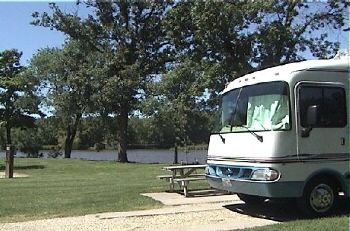
We went to the University of Wisconsin at LaCrosse to their archival department to see if we could get any additional information, but no luck, so we’re heading West.
MINNESOTA AND SIOUX FALLS, SOUTH DAKOTA
June 21 - 25. 2000
After leaving Wisconsin, we drove to Austin, Minnesota near Rochester
where we spent the night at another huge family campground. They
even had a complete selection of videos for rent at $1.00 each in case
of rain. The weather was clear and cool, after some thunder storms.
Could have spent more time in this state, but we decided to continue west
to South Dakota where we hope to find some information on Ray’s great-grandmother
who lived in Aberdeen in the first half of the 20th century. We arrived
in Sioux Falls in mid-afternoon on the 22nd, and did some shopping before
heading to the campground. It was in the upper 80's and really muggy.
We hooked up quickly and turned the air conditioner on.
Since we needed to drive to Aberdeen, and it was already Friday, we decided to spend the weekend in Sioux Falls. Can’t do much genealogical research on a weekend in any town, so why not just kick back and relax? We had a doozie of a thunder and lightning storm about three a.m., and I wondered about the people in tents in the campground. There is a woman right next to us in a small pop-up tent with a station wagon and a poodle. She said her husband is working seventy-five miles away where they have a 5th wheeler. I think I would have stuck with the 5th wheeler, which undoubtedly has a stove, an air-conditioner and a bed. But as Ray said, “Some people need their space.”
Anyway, we woke up to some crisp cleanly washed air, and set out on a gravel road with cornfields on both sides for our morning walk. I had this eerie feeling of being Cary Grant in North by Northwest, and when the small plane flew overhead, that clinched it. For a gravel road in the middle of two cornfields, the traffic certainly was not sparse. The big town of Tea, South Dakota was a little farther down the road, so folks from the campground were heading there for some Saturday morning business.
After we leave South Dakota, our telephone service will be reduced to the bare minimum, as there is no Sprint PCS service west of Sioux Falls until Coeur d’Alene, Idaho, and none in Canada. We will not disconnect our service, so our voicemail will still be working, and we’ll check our messages every few days. We’re not sure about email connections either. I may be able to send some through an internet address, but my email address will not change from mailto:rjlmpgbp1179@tennisonfamily.com. Sometimes I send things from online addresses, but my address doesn’t change. At least we’re more accessible than our son, Paul, who is currently on an African safari to the Ngorongoro crater, to Zanzibar and then up the mountain, Kilimanjaro.
ABERDEEN, SOUTH DAKOTA June 25
- 26, 2000
Talk about coincidences! Someone contacted me via email on
June 21st about researching Ray’s great-grandmother’s name in Wisconsin.
I got the email and responded that we had just been in Wisconsin and were
enroute to Aberdeen, SD to further research the name. She responded,
with an email address and a telephone number for a 1st cousin of Ray’s
mother who was near Aberdeen. We met with this 81 year old cousin,
Ralph,of whom Ray’s mother was totally unaware, and with his 80 year old
brother, Lyle, in Milbank, SD. I entered data furiously into the
computer as they poured out their memory banks with information about them,
their two sisters (two more we didn’t know about), their father and other
family members. We looked at old photograph albums and shared photos
that I have on the computer. We spent the better part of Sunday afternoon
with them, took photos, thanked them profusely and headed for Aberdeen,
armed with more information for research purposes.
Monday and Tuesday in Aberdeen gave us birth, marriage and death dates for Ray’s great-grandmother and family information hitherto unknown. We garnered bits and pieces on other family members, filling in gaps as we worked. If only I had photos to go with the names, but we do have the telephone number of Ralph and Lyle’s older sister who is gathering family information.
The other great thing in Aberdeen was the campground. We stayed at a city park which had a storybook land complete with figurines in a huge park. The figurines were incorporated into the play picture, as in the “House that Jack Built” which had a huge slide coming out of the side of it. It was great! And, since Aberdeen is the birthplace of L. Frank Baum, author of the Wizard of Oz, there was a Land of Oz, complete with a yellow brick road which leads from Munchkin land to the Haunted Forest and ultimately to the Wizard’s giant hot air balloon. There is a petting zoo, a larger zoo, a waterslide, two lakes with paddle boats and canoes, a train, bumper cars, and some kind of water bumper cars. All but the rides are free.
FARGO, NORTH DAKOTA June
27, 2000
We are definitely in “You Betcha” land. The family members
we visited in South Dakota were originally from Wisconsin, so the clipped
sentences weren’t apparent. However, when we stopped for dinner in
Aberdeen, the waitress sounded like the characters in Fargo. And
everytime we or anyone nearby requested something, she smiled and quipped,
“You bet.” By the 15th or 20th time she said this, I was afraid I
was going to burst out laughing. Now that we are in Fargo, the campground
attendant used the same, “You bet” response.
Fargo was named for William George Fargo of Wells Fargo Express Co. and ultimately, well, you know. Fargo is also the birthplace of the late Roger Meris. We drove on Roger Meris Parkway, and there is a museum in town with his baseball memorabilia. Fargo seems to be a “city” that is really a “big small town.”
Even though Montana is known as Big Sky Country, North Dakota could also certainly make that claim. Driving along the highway, the land portion in our line of vision seems minuscule compared to the expanse of blue sky scattered with clouds. If it weren’t so damn cold here in the winter, I bet it would be a great place to live.
GRAND FORKS, NORTH DAKOTA AND INTO CANADA
June 29, 2000
We spent a very rainy night in Grand Forks, then headed for Canada.
We are not unaccustomed to visiting foreign countries. We have traveled
to all the European countries, the United Kingdom, China, Hong Kong, Mexico,
Brazil, Australia, New Zealand and Canada. However, in all of our
travels, we have never been subjected to the kind of search we did on June
28th when we drove up to the Canadian border north of Grand Forks, North
Dakota.
We drove to the border and answered all the usual questions when crossing a border. Ray was unsure of the exact number of bottles of wine we had on board, so he made an estimate of six, clearly indicating this was an estimate. We were told to pull over to the side and wait for someone.
Within about 30 seconds, two young, polite agents approached us and asked us to step outside. They then proceeded to search every square inch of our new motor home. The woman crawled around on the floor looking under the table, chairs and in cabinets. She opened every compartment in our motorhome. The main storage in our motorhome is under the queensize bed which lifts up on spring loaded hinges. Our clothes are stored in stacks of like items throughout this area. The wine we were carrying was also in here, so it would be cushioned by the clothing. This entire area was torn apart as they looked for the wine. They unmade our bed, pulling down the covering and moving the pillows.
Had we known they wanted to see the wine, we would have gladly retrieved it, but they wouldn’t allow us in the vehicle. As it turned out, we did have too many bottles, so we had to pay a duty on them. And, when paying the duty, I was given a warning that if additional infractions like this occurred our vehicle could be subject to confiscation!
Now here is the really stupid part about this whole thing. They searched and messed up our entire living quarters, but never had us unlock any of the basement storage compartments. If we had brought in cases of wine or guns or whatever else, they would never have known.
We spent a day repacking the items in our home, so we can once again find things. I have never felt so violated in my life. I really don’t think we look like hardened criminals. We are 62 years old, clean, and neat and drive a brand new properly licensed vehicle. I would like to know if all American RVs are subject to this kind of treatment. If they are, I can’t imagine why Americans come to Canada at all.
WINNIPEG, MANITOBA July 1-2, 2000
Winnipeg is a modern city which hasn't quite reached the growth its founders intended. We visited the Manitoba Museum of Man and Nature in the Exchange District of Winnipeg and learned about the history of the area and of the people who inhabited it. The Metis were (or was) a tribe formed through the intermarriage of natives (called aboriginals here) and the European trappers. They settled and lived in the area as a separate nation. Later, of course, the Europeans came in full strength and dominated the land.
The Forks in Winnipeg where the Red River and the Assiniboine rivers meet is said to be a meeting place for 6,000 years. When you look into the water from the bridge, you can see a definite line where the two rivers meet. It is quite distinctive. A Riverwalk depicts Winnipeg's history, but much of it was closed due to flooding. The rivers and lakes throughout the Dakotas and in Canada are very high, and even flooded in some areas. Highway 29 between Fargo and Grand Forks had been closed for several days about a week before we drove on it.
A freeform arena at The Forks is a fascinating work of art/playground/rest. Huge brick freeform structures serve as perimeter walls and seem to be playground structures as well, as some have climbing pegs in them. A large outdoor stage was being readied for Canada Day performances on July 1st. We were there on June 30th. A prairie garden is also featured in one of the areas, but, as Ray pointed out, it really is just weeds. Black eyed daisies were the featured flower, but they were rather sparse
We decided to avoid the crowds on Canada Day and stayed put at the campground. We drove to Winnipeg on the 2nd to visit the Legislative Building (Capitol building) of Manitoba. An imposing Greco-Roman building featuring Italian, Tennessee and Vermont marble. The walls are of Tyndall limestone, which is interesting for all the fossils in it. They are everywhere on the walls and on the rails of the grand staircase. Atop the dome is the Golden Boy. This solid bronze statue, 10,000 pounds, of a boy with his hand outstretched to the north, the direction of Manitoba's expansion, is coated in 23.5 carat gold leaf. The story of golden boy is that he was cast in France when World War I broke out and the statue was diverted from its Winnipeg destination and rode a troop transport back and forth across the Atlantic for 2 years. Finally, when the ship was no longer needed for this, he was put on a train to Winnipeg.
Two magnificent life size bronze bison (more on this later) stand on either side of the grand staircase in the Legislative Building. They, too, were cast in France and shipment was received on them after the building was complete. The problem of how to get these huge bronze figures into the building without scratching and/or marring the magnificent marble floors was solved in a unique way. The heat in the building in a Winnipeg winter was turned off, the doors and windows were opened and the entrance hallway was flooded. When this was frozen, each bison was placed on a block of ice and slid easily into the building and hoisted to their resting position. The heat was turned back on and when melted, the remaining water was swept out the front door. Pretty clever.
Okay, back to the bison. When we were at the little zoo in Aberdeen, they had several bison/buffalo there. I admit I have never thought very much about this, but I don't know the difference. Ray didn't either, so we decided to ask our college age guide. Her answer was that bison are native to North America and buffalo are native to Africa. So, if she is correct, Buffalo Bill should really be Bison Bill. Naw, doesn't have the same ring!
I mentioned avoiding the crowds on Canada Day. Well, there don't seem to be any crowds in Manitoba. The campground we were at was only partially full on a four-day weekend (maybe it was just three days), The Forks wasn't crowded at all, and the highways are devoid of traffic. Mind you, we're not complaining, just observing.
One more interesting thing. As we drive on Highway 1, one of the major thoroughfares, there are fields of yellow which are the same yellow fields observed in northern Germany growing canola for canola oil. On fields, other than these distinctive yellow ones, there are labels–oats, barley, rye. Now, I'm assuming the farmers don't need these labels, so they must be for the tourists. Kind of nice, but I still wouldn't know the difference without the labels.
BRANDON, MANITOBA July
2, 2000
Brandon is an agricultural and industrial center. It is the
second-largest city in the province of Manitoba. There is a very picturesque
university in the center of town. This university is 100 years old
and many of the homes in the town are of the same age and very nicely kept.
The campground was filled with families enjoying the four-day holiday weekend.
There were multiple baseball diamonds and playgrounds, a basketball court,
horseshoes, miniature golf, outdoor checkers, beach volleyball and multiple
other activities. The campsites were extremely small, and we felt
like we were living in close quarters.
SASKATOON, SASKATCHEWAN
July 3 - 4, 2000
We pulled in to the campground in Saskatoon about 7:00 p.m. on July
3rd, had dinner and got set up in our campsite, and the sun was still shining
after 9:30. The farther north we get the longer the daylight hours
- not quite like Alaska, but certainly long days. By the time it
gets dark, it is time to go to bed.
One of the highlights in Saskatchewan, according to our guide book, is the Wanusekwin Heritage Park, a National Historic Site here in Canada. This fascinating place has 6,000 years of documented history. If you read Jean Auel’s book, The Mammoth Hunters, then you would understand the Buffalo Jump and the Buffalo Pound shown in the park. Ancient plains people hunted bison in two different ways. In the Buffalo Jump they would stampede them to a place where there was a drop, so the bison would go crashing down and be knocked out or disabled in some other way. The waiting hunters would then kill these animals necessary for food, clothing and shelter in this harsh land. In a Buffalo Pound they would herd them into a natural or man-made corral where they would be in a tight circle so the hunters could make their kill.
Archeologists have found thousands of bison bones from the centuries of hunting in the area. This large plains area has walking trails, or interpretive trails which seems to be the current word of fashion. We hiked into the park up to the buffalo jump, crossing a meandering creek and down to the river. We enjoyed a show of modern Indian dancing performed by one very nice young man who obviously wanted to be a stand-up comedian instead of an Indian dancer. He pointed out some of the modern and colorful items on his costume, such as CD’s, which I had already spotted. Other things he had purchased at Wal-Mart. It was a thoroughly enjoyable day.
Later we visited the University of Saskatchewan and the Diefenbaker Center. The only Diefenbaker I knew of was the white wolf who was the Canadian Mounty’s dog on the short-lived TV series, Due South. Seems Diefenbaker was a Prime Minister of Canada during the 1950's. More miscellaneous information to file in our crowded memory banks.
EDMONTON, ALBERTA July 5 - 8,
2000
We rolled into Edmonton the afternoon of July 5th. This modern
capitol of Alberta is a thriving metropolis and jammed with tourists heading
to Alaska. It is on the Yellowhead Trail which is the Alaskan Highway
and is the last metropolitan area before heading into the great Northwest.
The Muttart Conservatory was on our list of must-see items. The four pyramid shaped greenhouses of the Muttart are striking architectural structures, and their interior plant displays are enjoyable. There is a tropical, an arid, and a temperate pavilion. The remaining pyramid has seasonal exhibits, and we enjoyed the colorful summer display. The pyramids are in a large park with lawn, trees and additional floral beds. It was a sunny day and many Edmonton natives were picnicking and enjoying the park. Seems Edmonton has more parks per capita than any other city.
A guided tour of the 1912 Alberta Legislature building featured history of the building and of the province. A fountain in the lobby was installed in 1959 and inadvertently added one of those architectural phenomenon of domed buildings. When the fountain is on, there is a spot on an upper floor of the rotunda where you would swear the water is pouring down on your head. It is caused by the sound from the fountain bouncing off the marble steps opposite the spot. Just another bit of interesting trivia enroute. Outside the legislature building are some large decorative pools and fountains, where children and adults were wading and swimming on this sunny day. Security folks were just standing around, so apparently there weren't any restrictions against this. Canadians seem to be more free spirited in some ways than Americans.
Of course, the primary site in this town is the West Edmonton Mall, which claims the distinction of being the world’s largest mall, and I don't doubt it. Inside this mega mall there is an amusement park with 25 rides, including a triple loop roller coaster, and every other ride normally found in an amusement park. We're not talking small carnival rides here, we're talking about a full size amusement park. The NHL size ice rink was temporarily covered to host a Scottish Dance contest. But the waterworld with its large beach with a wave pool the size of a small lake (the world’s largest, naturally) was unbelievable. A waterslide at one end of the pool complex and was the largest I've ever seen. A full size replica of the Santa Maria shares a waterway with four submarines offering rides to view 100 species of marine life, including sharks, dolphins, and penguins.
Not being a mall person, I couldn't believe this place. We didn't go in to even one store but looked at everything else, like the large racetrack for those midget racers and a huge miniature golf course. An Inn and the Fantasyland hotel offer accommodations for those too weak to leave. The Fantasyland is a 354 room hotel which offers 118 “theme” rooms. When we were too tired to look anymore, we came upon the mega-screen theater showing the new Mel Gibson movie, The Patriot, so we went to see that. Great Flick - bloody, but great! When we came out of the theater, it was ten o'clock and still light outside. It did get dark by the time we were back at the campground and hooked up though.
From modern mall to history, we spent a day at Fort Edmonton Park. This historical park traces Edmonton history through four stages of its past. The Fort shows the fur trading era of 1795 to 1870 by depicting a huge fort based on original plans. The fort was not a military post but the place where fur traders from all over Western Canada came to trade their furs during this important time in Canada's development. Once the Dominion was established the 1885 Street shows how a settlement would have looked during this period. When settlements became municipalities, the 1905 Street depicts their era. And finally the metropolitan era comes alive in the 1920 street. We enjoyed the buildings and stores, a train ride on a full size train of the railroad era, and most fun was the streetcar ride from the 1920 era. It was complete with the straw seats we remembered from our childhood in Chicago. We rode the whole loop around to return to our starting point.
We apparently have been really fortunate weather wise. Seems they have had almost endless rain up here, but since we arrived it has been bright and sunny with cool temperatures. It is really ideal for everything.
Ray managed to get reservations in Calgary (not an easy feat during Stampede), so we're heading down there to the Wild West! Possibly won't have email for a while.
CALGARY, ALBERTA July 9 -
13, 2000
Cowboys and tourists from all over converge here in the heart of
Alberta cattleland for this ten day rodeo. The entire town of 800,000
folks is immersed in the Stampede. We checked into an RV park just
outside Calgary, overflowing with folks from all over. Lots of German
tourists here in the Canadian west seeing the sights using tents and RVs.
American caravans of RV’s took up about half of this park with its 200
sites. Breakfast and dinner are offered daily on a patio which features
live entertainment of country western singers nightly. They are pretty
good, too! Shuttle buses run daily into the stampede, returning twice
daily, with the last one at midnight.
The stampede itself is much like a state fair, with the rodeo being the main event. Food, rides, and booths where you can win stuffed animals fill the grounds. What you don't see at a U.S. state fair is a casino. There are casinos everywhere in Canada, and they are the same crowded, smoke-filled casinos that you know and love/hate from all over the world. The Stampede is not as large as the California State Fair or the Los Angeles County Fair, but what it lacks in size, it makes up in enthusiasm. And the weather is exemplary. We have enjoyed sunshine and temperate weather in the 70's the whole time here.
The shows are everywhere, and we enjoyed the singing sensation Shania Twin in one of her performances. No, its not a typo, she is a Shania Twain impersonator and is doing three packed shows daily. The entertainment, except for one show nightly, is free in various locations. The evening shows didn't have anyone we ever heard of, so we assume they are rock groups. The rodeo was twice daily, which means you could attend it twenty times if you were so inclined at this ten-day affair. We didn't, we only saw it once. The mystique of watching men who attempt to ride much larger animals who obviously do not wish to be ridden or to catch smaller animals who do not want to be caught is still fascinating. The appeal of their recently mended broken bones being exposed to the possibility of more fractures continues to amaze me. And the announcers love pointing out previous injuries just as the riders are about to be released from a gate from which a horse bred to buck them off is going to attempt to do it again. Guess you can tell I'm not rooting for the human contingent in these matches.
The Budweiser Clydesdales were here, too. These Canadian Clydesdales are every bit as impressive as the U.S. ones. We enjoyed their performance with a little bit of added excitement. Just at the end of their exhibition, something in the rigging broke and apparently jerked the wagon somewhat. The announcer who was riding on the wagon was caught off guard and fell off the wagon [no pun intended]. If you are familiar with the beer wagons, they are really quite high, and he was helped out of the ring limping noticeably. The rigging was quickly repaired, and these noble creatures took their leave.
Downtown Calgary was as busy as the Stampede area, packed with stampeders seeking the comforts of city-like entertainment. Artists in a pedestrian mall were plying their wares, and buskers of every variety were performing their hearts out. Local artists decorated life-size cows with colorful and amusing murals; they were interspersed from the civic center along the pedestrian mall. The Calgary tower (Calgary's equivalent of Seattle's Space Needle) stands out in the skyline of this modern city. Pedestrian walkways 15 feet above the ground connect over half of the downtown buildings for ease of eating and working downtown in Calgary's freezing winters. Glass skyscrapers dot the skyline, and a large stone turn of the century city hall is connected to its glassy civic center replacement by an overhead walkway. The Family of Man is a grouping of 21 ft. tall sculptured metal figures created for Expo 67. The nude elongated figures lack a discernible race and have their hands extended in gestures of friendship. Very impressive.
BANFF NATIONAL PARK July 13 - 16,
2000
No denying we are back in the Rockies - the Canadian part of this
mountain range is every bit as majestic as the U.S. portion. We pulled
into the park early our first day and went for a hike to explore the scenery.
Being cityfolk that we are, it took us less than an hour to get temporarily
disoriented. Suffice it to say, we took the long way back, taking
photographs of resplendent scenery along the way. Dinner then a bike
ride, and it still wasn’t even close to sunset yet.
The town of Banff is located in the National Park. It looks and feels a lot like the mountain town of Zermatt, Switzerland–same type of terrain, shops and homes. The town sits in a mountain-ringed valley with the Bow River and falls as added extras. We hiked along canyon walls and on catwalks to view a waterfall. More mountains and trees and lakes and my nose was running and eyes stinging. I finally figured out that if I’m allergic to a real Christmas tree, being surrounded by hundreds of thousands of them is possibly not a good thing. Three benadryl and some eye drops later, I was surviving and enjoying photographing bighorn sheep walking along the highway, mule deer grazing on the roadside, mountain goats posing for the camera, and chipmunks practically attacking tourists for handouts.
It rained during the night, and we awoke to fresh snow on the mountains surrounding us. Clouds were hovering in ethereal rings around mountain tops. No breakfast, instead we rushed outside with camera in hand to enjoy and record the beauty of it all. Once satisfied with out efforts, we ate, showered and dressed for the day.
Banff’s Cave and Basin is a Canadian National Historic Site. The discovery of this sulfur hot spring in the late 19th century led to the designation of Banff as a National Park. Also had to see Bow Falls, a mini-Niagara type of falls in the glacier-fed Bow River--very lovely. The falls are adjacent to the Banff Springs Hotel, an imposing structure originally built by the Canadian Pacific Railway for the wealthy first visitors to this vacation spot.
Back in to town, we strolled through the Cascade Rock Gardens, terraced gardens with waterfalls, bridges, pavilions, brilliant flowers, shrubs and trees. The view from this garden looks down the main street of Banff and toward an amazing mountain backdrop. We strolled the town shops with hundreds of tourists. Banff is the first place in Canada that actually seems crowded, but then, this is a really small town. Attended church in a tiny church that was filled with tourists, and the priest said the parish consisted of 100 people. Incredible!
LAKE LOUISE, MORAINE LAKE, COLUMBIA ICEFIELD
July 17 - 20, 2000
Undeterred by warnings of overcrowding at Lake Louise, we drove
up from Banff anyway. We decided the Canadian version of crowded
was possibly not the same as a New York, Chicago, or Los Angeles crowded,
and pressed onward. The campground has 189 sites, and like all other
campgrounds in Canadian National Parks, they do not accept reservations.
We arrived about noon and practically sailed in; however, when we caught
the bus a little later to go to Lake Louise, the line of campers waiting
to get in was about 50 deep. Good timing on our part. The shuttle
bus runs every half hour and saves the hassle of driving and looking for
parking at the crowded lake. The bus filled up and some folks were
still waiting, so they called for another bus which was to arrive about
ten minutes later. You can’t fault that for free service.
Lake Louise is every bit as incredible as we anticipated. The Victoria Glacier is the source Lake Louise’s turquoise glacial water. Chateau Lake Louise, another Canadian Pacific Hotel, commands the best view at the opposite end of the lake from the glacier. The lake and glacier are so stunning they look like a contrived Hollywood set. You can walk halfway around the lake towards the glacier, and it only gets more impressive. Since we couldn’t get as close to the Victoria glacier as to others in Alaska and in New Zealand, we couldn’t judge the respective sizes but the book says it is 200-300 feet thick at the top and 400-500 thick at the bottom. It is one big ice cube.
The following day we shuttled to Moraine Lake, another glacier fed lake 10 kilometers higher up than Lake Louise. Moraine is smaller than Louise and sits in a valley surrounded by ten glacier capped mountain peaks. You see what I’m leading to here–yes, even more spectacular. The thing that fascinated me most was, again, the color of the water; it was practically teal. And, once again, a Canadian Pacific hotel sits at one end of the lake with a commanding view. The road to the lake is only open from June to October though, so business must be done in a brief period of time. The lake remains over half frozen until mid-June. A lakeside trail leads to multiple streams of glacier melt which feed the lake and the Bow River which meanders throughout the area. Took loads of photos as usual.
Wednesday morning we headed north on Icefields Parkway to Jasper National Park and the Columbia Icefield. This is the largest body of ice in the Rocky Mountains and covers an area of 130 square miles. At the Icefield we took the SnoCoach tour in an incredible machine out onto the Athabasca Glacier. We boarded a shuttle bus which took us to the glacier, and from there we rode the SnoCoach onto the glacier. We drove on a depth of 1000 feet of ice and disembarked onto the actual glacier. The SnoCoaches are specially built buses with six tires which are over five feet tall each and about three feet wide. I’m talking SNOW tires here. Glaciers are fascinating things which always bring to mind the formation of mountains during the ice age, but this is right here and right now. The Columbia Icefield was first documented only 102 years ago, and from the crowds here today I would say its popularity has soared in just 102 years. We are really in the middle of nowhere, and the tour buses, RVs and automobiles were jockeying for parking spaces in the huge parking lot. The Icefield Center was teeming with tourists.
We are in a campground just a short distance from the icefield and from our window we can see one of the largest glaciers. The sun is just on the highest peak now after 9:00 p.m. and it will soon be in the dark. A ground squirrel on the side toward the mountain we are nestled against is busily packing food into his huge cave. A rabbit keeps running back and forth across the front of the campsite, and I think the noisy Clark’s Nutcrackers have finally settled down for the night. Not a bad way to spend an evening–finished my book too.
WINFIELD/KELOWNA, BRITISH COLUMBIA
July 21 - 24, 2000
Driving from the Lake Louise area to the west, we drove through
Canada’s Glacier National Park. The park is on the Trans-Canada highway
and has numerous glaciers with mountains on either side of the highway,
but having just departed the Columbia Icefield, it seemed somehow anticlimactic.
Now, if you were coming from the west and heading to the Icefields, this
would have been a terrific introduction to the majesty of glaciers, but
it just doesn’t work in reverse. We spent the night in a little town
called Revelstoke which is in Mount Revelstoke National Park.
We left the Rocky Mountains somewhere in British Columbia and found ourselves in rolling hills of farmland and lakes. Yes, the lakes are often bordered by mountain peaks, but the lakes are the stars in this land of the Okanagan. We settled in to a resort park to spend a few days just relaxing. They were celebrating Christmas in July complete with judging of Christmas decorations on RV sites, visits from Santa Claus and a Christmas dinner with all the trimmings served in the Golf Club restaurant. There are about 1000 sites including condos, RV sites and permanent park model sites at this plush resort. It sits on a little lake (not the Okanagan) and has multiple swimming pools, hot tubs, a library, an activity center a recreation center, a golf course and a couple of restaurants. A nice place to spend a week, actually only five days.
HOPE AND ABBOTSFORD, BRITISH COLUMBIA
July 25 - 29, 2000
We left our nice RV resort and headed west to spend the next night
in Merritt, but somehow we wound up on a great toll road which landed us
in Hope, B.C. Found a campground and spent the night. Ray read
the literature on this tiny mountain and was fascinated by its unofficial
title of “Chainsaw Carving Capital.” So, the next morning we headed
into town to take the walking tour of the local art work. They don’t
mess around with chainsaws in this town. The first stop on the walking
tour was a Royal Canadian Mounty standing at attention in full dress, possibly
about 12 feet tall. The rest of the twenty or so figures included
eagles in flight, salmon swimming upstream, and various other native animals.
The figures were all lacquered or whatever to a high shine, undoubtedly
for protection from the elements. The whole thing started when a
large tree in their central park was diagnosed with root rot. Citizens
were upset over its loss, so a local artist suggested they leave a 12 foot
stump, which he then carved into an eagle in flight with a salmon in its
talons–pretty impressive. From there the project expanded, and the
artist kept himself and others busy with their little saws. Several
of the figures were in a delightful park on the banks of the Frazier River.
Flower gardens abound in this part of British Columbia, and homes are as
colorfully emblazoned as city parks.
The RV park in Abbotsford describes itself as a mountain getaway spot, and it certainly is. Up winding mountain roads to the level campground with a large grassy field in the center with campsites surrounding it. The “resort” as it is called, is a very interesting place, and we couldn’t figure out how they get enough revenue to keep it going. We have a camping membership which allows us to stay at thousands of places for $5.00 American per night, so with the exchange rate, we figured we would pay about $7.00 Canadian. Well, this place came out to be under $10 Canadian for three nights instead of the posted $25 per night for people without memberships–go figure!
Heritage Valley Resort has an indoor swimming pool, two indoor tennis courts, a clubhouse and three lodges/dormitories. There is an outdoor garden on a pond with a small waterfall which has a footbridge, a gazebo, a garden archway and a landing/patio. The area is beautifully landscaped with flowers and shrubs in colorful displays. This was adjacent to a two-story building whose top floor was a banquet hall and was set up for a wedding. We hiked around the area and picked enough blackberries for our morning breakfast cereal and took photos around the garden at the pond.
We were in a heavily wooded area so didn’t bother with the satellite TV. I finished one book and started another, Ray finished his also, and we played Scrabble. Now I’m not saying Ray isn’t enjoying retirement, but he needs to be with other folks for some competition at cards or sports or something. Get this. He has a computer spreadsheet set up to track our Scrabble games. It keeps track of who started each game, how many turns it took us to complete it, and, of course, who won. Help! Somebody else come and play cards or anything with this man.
Sunday morning we left our little mountain getaway to go to church in the nearby town of Abbotsford, but zigged when we should have zagged (we do that a lot and it doesn’t faze either one of us)and wound up instead in Mission, B.C. We found a church and were miraculously only ten minutes late for Mass, and that is when lots of folks regularly arrive.
Oh, I mentioned the satellite TV. We now have an interesting setup. We can receive the major networks–CBS, NBC, ABC, and Fox–from both New York and Los Angeles. So, if there are two shows at 8:00 that we want to see, we can watch one from NYC at 5:00 and the other one from LA at 8:00. Not that such a thing happens very often, as there really is not much to see on TV, but believe me, Canadian TV has greater deficiencies than U.S. Thank heavens for old movies.
BLAINE, WASHINGTON August 1-10, 2000
With trepidation we headed south to go a resort just four miles beyond the U.S. border. We forgot we still had two grapefruits and an orange in the refrigerator, so we ate them at the border crossing and called it lunch. The U.S. Agriculture agent took the peels for proof. Checked in to the resort to just hang out for a while until we get Monica in Vancouver. My back decided it was a good time to go out, so I took things very carefully for almost a week. Actually, timing wise, it wasn’t bad at all, since we didn’t have anything planned anyway.
We have been going for long walks in the morning, and Ray rides his bike later in the day. I have skipped the bike riding because of the back, so without me he has been going great guns. Had the time here to read, do some chores and computer work. The exchange-a-book library here is extensive, so we got rid of a bunch of books we have both read and picked up replacements.
Yesterday, August 9th, was our 42nd Wedding Anniversary, so we decided to celebrate by going out to dinner. There is a very nice looking restaurant right next door to the RV Resort here, so that was our choice. I dug out some “real” clothes, not shorts/fatigues and a t-shirt, but a real blouse, slacks and a jacket with shoes other than Reeboks. Found some makeup that wasn’t totally melted and put on some perfume (not the insect repellent I normally wear). Ray was really impressed! Anyway, the restaurant was superb–equal to any in the Bay Area. We brought our own wine, but they had an excellent wine list. The roast duckling with orange sauce was marvelous, as was Ray’s steak. Their bread was sun-dried tomato and jalapeno, but the jalapenos weren’t noticeable. The veggies were not the usual side of zucchini or other squash but a combination of tomatoes, mushrooms and spinach that was delicious. I had wild rice with my duck that Ray, the rice eater, looked longingly at. Wow, it sounds like I haven’t been out to dinner in a while. Ended the meal with some chocolate decadence–it was our anniversary, after all.
We’ll head back to Vancouver on Friday (yet another Canadian border crossing) in order to get Monica at the Vancouver airport on Saturday morning.
VANCOUVER, BRITISH COLUMBIA
August 12-13, 2000
Picked up Monica at the Vancouver airport and took one sleepy kid
to the Bloedel Conservatory at Queen Elizabeth Park and enjoyed the sunny
weather, beautiful flowers, ducks and gees along with tourists, wedding
parties and Vancouverites. We had lunch and headed to Grouse Mountain
for the Capilano Tram ride to the top of the mountain. Crowded but
we enjoyed the tram ride up, the logging show/comedy routine, and more
chainsaw carvings. They have bigger trees in Vancouver than in Hope,
so the carvings are bigger. The views from the top of Grouse Mountain,
though a bit hazy, spanned the entire city of Vancouver and its surrounding
waterways. Quite spectacular! An IMAX theater featured a presentation
that I bet was left over from Expo 86.
Reminiscing about our 1986 visit to Vancouver’s Expo 86, we decided to visit one of its survivors, Canada Place. The magnificent sails on the roof that we remembered weren’t visible until we were right next to what is now a convention center. Docked on either side of it were cruise ships–a Holland America on one side and a Princess line on the other side, and each was large enough to obscure most of a building that I remembered as much larger. They had an IMAX theater that just happened to be showing Michael Jordan to the Max. I never wanted to suffer through that final championship series again, much less that final game with Utah, but in the IMAX the whole thing was even bigger. It was quite enjoyable.
Finishing our sightseeing in Vancouver we headed for the U.S. border, along with hundreds of others on a Sunday evening. It took us an hour and fifteen minutes in traffic to get to the crossing, which took less than a minute. Next stop, Seattle.
SEATTLE, WASHINGTON August 14-15,
2000
Seattle Center was our primary target for sightseeing our first
day in this northwest city. Lots of other folks wanted to visit the
Space Needle too, so we all waited together in line for the elevator.
The view was great on a SUNNY, clear day in Seattle. Approaching
the Seattle Center and from the top of the Space Needle, a new item on
the landscape couldn’t be missed. A large metallic, multicolored
freeform structure sits at the base of the Space Needle, which we learned
was the EMP or Experience Music Project which just opened in June 2000.
The multi-million dollar structure/center was financed by one of the co-founders
of Microsoft and is sort of a Rock and Roll museum. We walked through
the public parts of this edifice but didn’t buy tickets for the performance/tour
since I can hear enough of that kind of loud music when cars and trucks
with it blasting pull alongside us.
The International Fountain is a spherical fountain that shoots water sporadically from multiple spigots at varying distances sits on a funnel shaped foundation and adults and kids were running throughout the sprays. Key Stadium is adjacent to the International Fountain and Pavilion of Flags in Seattle Center. A tiny amusement park obviously dates back to the 1962 Worlds Fair which started the whole thing, and the unexciting rides weren’t drawing many modern day thrill seekers.
A morning trip took us to Snoqualmie Falls, a 270 foot waterfall {100 feet higher than Niagara Falls). In 1898 a power plant was built beneath the falls to provide hydroelectric power to the surrounding area. Plant 2 was added in 1910 and later expanded in 1957. This Puget Sound Energy plant provides enough power to serve 16,000 average homes. Interesting, educational and scenic–not bad for a morning of sight seeing.
The afternoon was spent at the Museum of Flight viewing early airplanes, a spy plane, early passenger planes, and the Air Force One used by Presidents Eisenhower, Kennedy, Johnson, and Nixon. We had a docent tour by a retired aeronautical engineer which was certainly complete.
MOUNT RAINIER NATIONAL PARK
August 16, 2000
From the Northeastern corner of the park we drove along the eastern
perimeter and then over to the Paradise section of the park where the wildflowers
were supposed to be abundant. We weren’t disappointed. Dead
Horse Creek Trail leads up to the spectacular glacier covered volcano through
an alpine meadow of magenta, fuchsia, yellow, lilac and white blossoms
that almost outshine the glaciers–almost, but not quite. The Rocky
Mountain Glaciers in Canada are certainly more abundant and larger than
those on Mount Rainier, but the surrounding meadows made the visit to Mount
Rainier well worth the trip. The day was sunny and warm, and the
mountain glistened above the flowers. Ray and Monica hiked high enough
for Monica to walk on a glacier–I hiked back toward the circular visitor’s
center to view exhibits and see the mountain climbers through the telescope.
MOUNT ST. HELENS NATIONAL VOLCANIC MONUMENT
August 17, 2000
Winding mountain roads with multiple switchbacks led to the volcano
that erupted just twenty years ago. We began the trip from Randle
through farmland with horses and cows grazing alongside the road.
We turned into a rich forest land of evergreens and a forest floor covered
with lush ferns. Higher up the forest lost its fern floor but was
multiple shades of green with imposing trees. Then gradually, the
trees became sticks, and we entered what looked like a surreal landscape
from some science fiction movie after the earth has been through a nuclear
war. Huge grey trees lying everywhere on a barren grey floor were
cracked and brutally thrust at odd angles. We have never seen anything
like it. A visit to Volcano Park in Hawaii is nothing like this.
The lava and sulphur in Hawaii are the stars, but here there is only grey
devastation. After twenty years, the land is recovering, and the
wildflowers we saw at Rainier are also in bloom, sparingly, at Mount St.
Helens. Tiny trees are visible as is shrubbery in many places.
The naturalist assured us that in two to three hundred years, this area
would once again be lush and green–barring additional eruptions.
En route back to the campground we stopped at a lovely waterfall in the forest, just to assure ourselves that, “All’s right with the world.”
COLUMBIA RIVER GORGE NATIONAL SCENIC AREA
August 18, 2000
We checked our GPS and map program for the way to get from the campground
in Randle, Washington to the Columbia River Gorge and started our short
100 mile trip. The road was a National Forest highway which seemed
to be getting suspiciously narrower as we progressed. A couple of
cars coming from the opposite direction seemed strangely dirty, and we
soon learned why. The next sign we saw read, “Pavement Ends.”
For about 12-20 miles (depends on whether you’re talking to Ray or to me)
we drove on a gravelly washboard road that shook our back teeth loose.
Finally we arrived at a paved road and made our way to the Columbia River.
A mist turned to a fine rain. and the stop at Cascade Locks, Oregon turned
into a late lunch stop instead of the sternwheeler cruise we planned.
Once across the Columbia River we took the scenic route to view the multiple
waterfalls there and a little way down the road, the sun came out.
PORTLAND-SALEM, OREGON
August 19-20, 2000
Our week with Monica was up, and we took her to the Portland airport
for her return flight to Walnut Creek. After seeing her off safely,
we did some shopping then returned to our RV park for the night.
Ray called his 89 year old uncle who lives in Salem, and we visited with
him on Sunday afternoon. We then pulled into a Salem RV park and
did laundry and a thorough RV cleaning inside and out, which we had
sorely neglected while entertaining a houseguest.
CRATER LAKE NATIONAL PARK, OREGON
August 21-22, 2000
Driving down I-5 toward the turnoff for Crater Lake on Monday we
left the green fields and lush hillsides about ten miles north of Roseburg
and entered the dry browned grassy hills that look like what Californians
refer to as golden hills. Drove through more winding mountain roads
toward Trail, Oregon on an approach to Crater Lake.
We entered Crater Lake National Park Tuesday morning and decided to take a wildflower hike before approaching the lake. Poor move, it was quite disappointing. Flowers were small and sparse and nothing like those in the meadow at Mount Rainier.
On to the spectacular lake surrounded by mountains, volcanic peaks and evergreen forests–it just takes your breath away, it is so spectacular. That little ViewMaster I had when I was a kid was my introduction to Crater Lake (they were selling them in the gift shop there), and the first time I saw it in person was twenty years ago. It hasn’t changed a speck, and probably won’t for centuries. Mount Mazama is the volcano that erupted 7700 years ago and then collapsed inward to form the crater for the lake. Indians said nothing of the lake’s existence to trappers and pioneers for 50 years, so it wasn’t discovered by Caucasians until 1853 when prospectors were searching for the Lost Cabin Gold Mine. Crater Lake is over 1900 feet deep and is the deepest lake in North America (sixth deepest in the world). The vivid blue color of the water is attributed to the total lack of pollution therein. The lake water is entirely from rainfall and/or snowmelt and has no streams feeding into it, hence no pollution seeping into it.
Exiting the park we followed the Rogue River and stopped to view the rapids and falls of the Rogue River Gorge. The volume of water is such that in one minute enough water passes any point to fill an olympic size swimming pool. Gorgeous river and worth a trip itself.
ASHLAND, OREGON
August 23-24, 2000
For my birthday we were in Ashland, Oregon, home of the Shakespeare
Festival. Twelfth Night was playing, and we got tickets in Row E
dead center. Couldn’t ask for a better birthday present than that.
We chose a little French restaurant for dinner that was superb; its prices
matched San Francisco’s, but so did the food. The weather was atrociously
hot during the day, but at night the outdoor theater was quite pleasant.
The performance of Twelfth Night was great. I haven’t seen it since
we took the kids to a DePaul University presentation when someone (Mark,
I think) was studying it.
MC CLOUD, CALIFORNIA
August 25-31, 2000
For the third or fourth time our air conditioner in the cab didn’t
seem to be working quite right, so we got an appointment in Dunsmuir to
have it looked at. They found a valve that was leaking freon, so
hopefully this is a final fix. But, we were just fifteen miles from
McCloud Square Dance Country, and I knew it was Bob Baier’s week, so we
decided to try to get in. Got a place at the RV Park, and there was
room for us at dancing.
It was like old home week, since we knew most of the dancers there. We enjoyed A2 dancing, afterparties and food–lots of food–opening buffet dinner and champagne afterparty on Sunday, peanuts at the campfire on Monday, Tuesday potluck lunch and hot dog/marshmallow roast at the campfire, potluck dinner then a pie afterparty on Wednesday. We drove to the Mount Shasta ski lift area on Thursday for a brunch followed by a ride on the lift up the mountain, then some dancing and a farewell buffet. Good thing we were square dancing to counteract all that food!
CONTRA COSTA, CALIFORNIA September 1-12, 2000
We returned to the Bay Area in time to see Gail and Monica before they flew to Brussels. We attended to some business, played cards with friends, got out suitcases for our trip. Ray flew to Arizona to visit his mother, and I drove to Manteca to visit with relatives there. I babysat for Selina, went to the theater to see A Chorus Line and got my hair cut (really needed that). Mark will visit here from Los Angeles this weekend, and then we will depart for Europe on Tuesday, the 12th. We have tickets to the Passion Play in Oberammergau and hope to get to the World’s Fair in Hanover, among other things while we are there. We'll send a report when we return.
EUROPE BOUND - GETTING THERE
September 11-13, 2000
Took a first look at our e-tickets for Frankfurt the day before
we left and discovered we had no seat assignments going, but we did have
them returning. All we could get were inside center seats–it’s going
to be a really long flight. On the morning of our departure we got
up early to take our home over to its storage place. First time we're
leaving it all alone like this. Hopefully we covered everything.
Lloyd took us to the San Francisco airport and no sooner had he driven off when we discovered the camera was still in his car. Thank heavens for cell phones. Lloyd returned with camera in hand, and we checked in. We managed to get two seats together on the aisle, so it wasn't as bad as we had anticipated.
I got practically no sleep on the plane. The lights weren't bright enough to read by, and they were showing four different movies continuously on our little individual screens, but since headphones give me a headache, I passed on the movies. Mostly I watched the GPS showing where we were and how fast we were going. Better than a lot of prime time TV shows.
We met Ray’s brother, Rich, and wife, Roswitha, in the Frankfurt airport, picked up our rental car and proceeded to a Gasthaus in Obernhain where they had a room booked. We did some sightseeing at the Roman ruins in Saalburg and visited Hessenpark, a sort of Williamsburg-type place. After a huge German dinner we joined in the “reunion” that Rich and Roswitha had with three local German couples they met nine years ago in the same Gasthaus. One of the couples spoke English, so Roswitha had to communicate with the remainder of them. The room was heavy with smoke and we hadn't slept in 48 hours, so we took our leave early.
September 14-16, 2000
KASSEL-HANOVER
We had a leisurely (read late) breakfast before setting off on the
autobahn. Our first stop was Kassel, Roswitha's hometown, and also
the home town of the Brothers Grimm, of fairy tale fame. She wanted
to visit one of the sites of her childhood, Wilhelmshohe Park, where a
gigantic statue of Hercules stands at the park's highest point. The
statue is a 1717 copy of the Farnese Hercules at the National Archeological
Museum in Naples. Hercules is 236 feet high and stands atop a pyramid
which stands on top of an eight sided pavilion. No wonder she remembered
it as a kid, it is practically in the sky! Anyway, we stopped, took
the requisite photos of the now somewhat crumbling monument and continued
on our way to the World’s Fair, or Expo, in Hanover. We stopped in
Hildesheim at a Gasthaus for the nights we were going to be visiting the
fair.
EXPO 2000 - HANOVER
After breakfast we drove to Expo 2000. The day was overcast
and the crowd was sparse. I'm not sure how many countries participated
in this World’s Fair, but the United States wasn't one of them. I
have no idea why, and no one offered any reasons. We visited as many
pavilions and covered as much of the fairgrounds as was humanly possible
in a day, but even with the meager lines we still could have used several
more days.
Iceland's pavilion was a multi-storied blue cube with water cascading down all sides. The interior was a circular ramp around a circular floor screen where aerial photos of of Iceland were projected.
Japan had a huge elongated igloo-like structure made entirely of recycles materials. Their theme was energy conservation and recycling in planning the future of Japan. Ray’s automated highway, which he has been harping on since the 1950's, was envisioned in the future of Japan. Was he happy to see that!
A huge teepee, spelled tipi, had nothing to do with Native Americans but held a stage for local performers. We had lunch at the Irish Pub and were served by a young French-Canadian woman. The number of visitors at the fair increased as night fell and the night spots came alive. We were totally worn out and headed back to our Gasthaus.
TRIER
Drove most of the day in the rain heading from Hanover to Trier.
Stopped for lunch at a Chinese Restaurant in a tiny town enroute.
Spent the night in Wolsfeld at the Hotel Post, a tiny hotel with a great
restaurant where we spent the evening playing cards as the locals were
doing. The next morning was overcast and foggy, but we continued
to Trier, Germany's oldest city. It sits on the French border on
the banks of the Moselle and was founded by the Roman Emperor Augustus
in 16 BC. Its history is long and colorful figuring in every phase
of European history including the birth of Karl Marx there in 1818.
The Porta Nigra in Trier was originally the northern entrance to the walled
city in the 2C and by the 11C it was transformed into a church on two levels.
In 1804 Napoleon ordered the monument restored to its original form.
The Roman baths in town date from the time of Constantine. Fascinating
little town teeming with history. Would have loved to spend more
time there.
LUXEMBOURG
We were too close to Luxembourg to miss it. This tiny country
surrounded by France, Belgium and Germany is only 50 miles by 35 miles
in size. We drove to the city of Luxembourg where we found the streets
blocked off and a sort of “mini” Tour de France taking place. We
watched the cyclists warming up, then racing, enjoyed the food from the
street vendors, did some shopping and then made our way back through France
to Germany. Saw our first Wal-Mart as we returned to Germany.
We stopped for the night in the town of Pirmasens where a festival in the central square was celebrating something with their French sister city. Had dinner at an elegant Italian restaurant in this German town where they played Dean Martin recordings in English.
September 18-23, 2000
MUNICH AND DACHAU
Next objective was to make it to Munich for Oktoberfest, as Ray’s
brother, Rich, wanted to experience its excitement. En route we stopped
in Ulm and headed for the church steeple that we saw from the distance–actually,
Ray always heads for the church steeple. As it turned out, his instincts
were right on this time because this particular spire happens to be the
tallest in the world, standing at 528 feet. The foundation for the
cathedral itself was laid in 1377, but the towering spire wasn't erected
until 1890. Aside from its height, the cathedral was non spectacular.
We then waited patiently for the clock in the cathedral square to go off
at 3:16 p.m. It played several tinny tunes and had some figures perched
on the side of a building that moved slightly. Like the cathedral,
it was non spectacular. So–onward to Munich!
Because of Oktoberfest, we knew hotel rooms would be difficult to get, so we stopped in nearby Dachau. Going from place to place we drew guffaws from some clerks until we found a greedy one who offered us rooms for cash only with no receipts at an exorbitant price. We got him down on the price somewhat and took the rooms, but we weren't sure we wouldn't be evicted in the middle of the night, since we had no proof we were supposed to be there. With trepidation we left our hotel and proceeded to Munich. While roaming around town an American, named Bill, from Pensacola took us in custody and volunteered to show us the ropes of the Munich underground. He walked with us to the transit station and went through a myriad of ticket schematics. We finally were able to thank him profusely and graciously “shake him.” We decided that a taxi would be much more efficient and possibly cheaper. Had dinner in town and decided to postpone the Oktoberfest experience until the next day.
I wanted to do the tour of the Dachau Protective Custody (concentration) camp, and my traveling companions were not really keen on the experience but decided to come along. The tour turned out to be an full day's event. The huge camp was cold and forbidding. The video presentation in English was filled to its capacity of 250 each time it was shown, and a showing was added one time to accommodate those who didn't get in. The English speaking tour was divided into two large groups. The young man who was our guide was excellent; he was from Dachau and said he had been delving into the books for two years, and he spoke of interviews he had with inmates from the camp. He felt very strongly about making certain the world knew the truth about the concentration camps, so their terrible history will never be repeated. We were all pretty quiet the rest of the day and really worn out by emotions experienced during the tour. If you are ever near Munich, I highly recommend it. Everyone should be aware of what took place here in the twentieth century.
More entertaining prospects were planned the following day. We arrived in Munich in time for the 11:00 playing of the Glockenspiel, the carillon whose mechanized figures enact the Dance of the Coopers and the jousting tournament which accompanied royal weddings in the 16th century. We visited Peterskirche, the 13C Gothic church, Munich’ oldest church and Frauenkirche, a late Gothic hall church, which is Munich's largest church. Visited with a charming Munich resident who was anxious to share his city with us tourists. Told us about the churches I just mentioned, and he pointed out the bricks in the Rathaus which didn't quite match the rest of the bricks and said they were the ones used in the restoration after the WW II bombings.
Rich and Roswitha were more interested in the bigger tourist attraction, the Hofbrauhaus, the beer hall dating from 1589. We arrived after our sightseeing and found them entrenched in a booth with four Berliners wearing Mad Hatter Oktoberfest hats, hoisting liters of beer and singing to every toast. Sitting in the Bierschwemme, the hall fulfilled the guide books description with its odors of strong tobacco, sausages and beer. The oomph pah band played continuously. Somehow it seemed louder than our previous visit several years ago, but then I was younger. . .
We spent the afternoon walking down Maximillanstrasse, the 5th Avenue and museum row of Munich. It boasted the usual cafes and restaurants with outdoor accommodations and one even had a “Doggie Bar” for those with pets. It was a double dish with food in one side and water in the other. We came across these in several locations during our trip. Nice idea.
The evening, of course, was for Oktoberfest, Munich's most famous event. It began in 1810 to honor Ludwig I’s marriage, and everyone had so much fun that it continued annually. Today it is sort of the Bavarian “state fair” and is one of the largest fairs in the world. The Midway boasts carnival booths and amusement rides of all varieties, and the beer tents sponsored by the local breweries are huge. Each smoke filled tent holds up to 6,000 people, and each tent was full the night we visited with the outside seating scarce too. The tents serve beer in liters, chicken, pretzels, music and merriment. Participants drink, eat, sing and dance on the sturdy tables. During the 16 days of Oktoberfest an estimated six million visitors guzzle over a million gallons of beer and eat 700,000 broiled chickens. I've never seen so many drunks in one place in my life! What a hoot!
OBERAMMERGAU - The Passion Play
- September 21-23, 2000
Next morning we were ready for a change of venue. Following
a leisurely breakfast, we hit the road for Oberammergau, a climb into the
mountains. Picked up our package tickets in town and determined it
was too early to check into the hotel, so we had time to kill. It
was pouring rain, and the town was quite small. A visit to the local
museum of play paraphernalia didn't take nearly enough time, so we hit
the shops in the rain–lots of wood carvings, but no room in our little
home for such things. Our package includes two nights hotel, all
meals (two dinners, lunch and two breakfasts) and transportation to the
play. The play is six hours long beginning at 9:30 a.m., breaking
for lunch for two hours, and resuming for three hours in the afternoon.
The day of the play everyone was up early to put on all the layers of clothes to keep warm on this sunny but cool day. Had breakfast then took the bus from our hotel in Ettal to the Passionplayhaus in Oberammergau. Excitement was in the air as folks from all over the world waited for the gates to open. Lots of Americans, and most of us were senior citizens.
The new theater was built for the 2000 Play and is open air but has a roof over the audience. Fortunately the rain had stopped, so we didn't have to watch soaking wet performers. The seats are wooden theater type, slightly padded–emphasize slightly. Because the empty stage was roofless and the 4,000 seat theater is so large, the enormity of the stage didn't register until the throngs of people and animals began to populate it. A man on horseback throughout one entire scene just blended in with the surrounding crowd.
The play itself defies description. Suffice it to say, if you have some free time in the summer of 2010, schedule it in. And, since you have ten years, learn German. It was truly spectacular and since we already knew the story, the German speech didn't detract. We had English translations to refer to whenever we wished. An outstanding chorus of fifty acted as narrators in each scene, and the English translations were helpful for their songs.
The production has 2000-2500 townspeople fulfilling the vow their ancestors made in 1633 to perform the drama if the remainder of the town would be spared from the Black Plague. Anyway, during the condemnation of Christ, most of the cast was on stage, producing an amazingly compelling scene. The images of the carrying of the cross, the scourging and the crown of thorns were readily identifiable from religious paintings throughout history. However, no matter how familiar the crucifixion was, it did not seem contrived. We actually witnessed it! Go see it in 2010!
NUREMBERG - September 23-24, 2000
We arose in Oberammergau at 4:00 a.m. in order to make the drive
to Munich Airport for Rich and Roswitha to catch a 7:00 a.m. flight to
Turin for the continuation of their trip. With such an ungodly early
start, we arrived in Nuremberg before the town was up. As we were
trying the doors on a 13th century gothic church, a man approached us and
said to follow him as he was going to open it. This church was almost
totally destroyed by WW II bombs but is totally reconstructed.
Lorenz Platz in front of the church is one of the main squares in the old walled city of Nuremberg, and we found ourselves in the midst of a huge city fair celebrating the 950th Anniversary of the founding of Nuremberg. Booths of merchandise and food were everywhere, just like a state fair but without rides. Local folk dancing on the central stage resembled clogging with different costumes. Food and goods for sale everywhere including a huge farmer's market which we later learned was an everyday event. It was very crowded, with an international crowd.
Sunday morning after breakfast we attended Mass at St. Mary's Church which is the oldest church in Nuremberg. It was built in the 13th century for the Emperor Charles IV to worship there. It has an original working clock with gilt figures on the tower which strikes daily at noon. A series of colorful metal jacks represent the seven Electors coming to swear allegiance to the Emperor after the enactment of the Golden Bull in Nuremberg in 1356. A robed Madonna of Adam Krafft dates from 1498. The altar in the chancel garnished with human figures is a masterpiece from 1445 and depicts the Crucifixion, the Annunciation and the Resurrection. After the WW II bombing, this church had only three walls standing.
The church and town hall stand on the town square which the church appropriated when it tore down a Jewish temple and homes of Jewish residents. They subsequently banned Jews from the city because they “may have started the plague.” This and so much more information we received from our English walking tour. I was feeling pretty punk suffering from a German version of Montezuma’s revenge so wasn't certain I could endure the entire 2 ½ hour tour; however, when our spunky tour guide who was clearly ten to fifteen years my senior arrived, I knew I’d grit my teeth and get through it. She was a lifetime resident of Nuremberg who remembered the bombings and had a lifetime of information and memories to bestow on us.
The town square was elevated to eliminate the wet ground, and the emperor decreed no houses were ever to be built there–it was for meetings and festivals. He also decreed the 14th century Gothic fountain with figures depicting Biblical stories for the people, since the common folk couldn't read and needed visuals. The fountain in the square sports gilded Biblical figures that are 100 year old replicas. A schloss dates from the 12th century and was added to by Maximillian in the 16th century. The chapel and some other portions of the schloss remained intact after the bombings, and everything else has been reconstructed.
Before WW II Nuremberg was one of the most beautiful medieval cities in Germany. Whole blocks of half-timbered houses with embellished gables made it a typically “Germanic” city. The entire square and old city were 75% destroyed during the bombing, but the church clock, statues, stained glass windows, Biblical fountain and all other town valuables were removed during the war and stored in ninety foot deep cellars below the old city. These cellars had been there for centuries having been dug for the townspeople to brew and store their beers. Since the 13th century commercial and residential sections of the city have been divided by a bridge designed after Venice's Rialto bridge. The bridge bisects the town in the center over the River Pegnitz.
Decorated bay windows on buildings are actually private prayer chapels which were once required so folks could do their praying without actually going to church. The walled city of Nuremberg with 123 towers (67 still exist) was also totally self-sufficient. The high roofed houses had storage for one year of food and grain in case the city was under siege. Additionally, seven grain warehouses kept more stockpiled if the siege were longer. After the bombing of World War II only 250 houses remained in Nuremberg. When the town was rebuilt the new ones were required to have the same steep storage roofs as the old ones.
On the edge of town one entire street which had housed the smelly leather workers escaped the bombs. These half-timber houses still have their original extended gables sporting pulleys used to haul supplies up to the 4th and 5th story workplaces. The ground floor of the houses were sandstone, but the upper floors were half-timber because the city gave free wood to construct them in the 13th century.
In 1400 one of the bridges was replaced by a newer one, but the thrifty citizens of Nuremberg didn't want the old one to go to waste, so they built a house on the older one for the town hangman. That way this undesirable character wouldn't actually be in town, but would be close enough for his job. The house/bridge served this purpose for 400 years. It now sports a ping-pong table for the adjacent Youth Hostel.
Within the walled city stands the basilica of St. Sebald. This Lutheran church was a Catholic church until Catholicism was outlawed in the 16th century, but the elaborate tomb of St. Sebald remains in this Lutheran church making it the only Protestant church with the relics of a saint in the Catholic faith. Also remaining are the numerous statues of saints which the thrifty townsfolk had paid for and decided to keep in their now Protestant Church.
On the south-eastern outskirts of this once beautiful medieval city stand the massive Nazi Party Rally Grounds where Hitler ordered the creation of appropriate architecture for his mass rallies. From 1933 to 1938 each September up to a million people attended the week long rallies held here. The Nuremberg Race Laws were passed here, the laws which robbed the Jews, and later, other minorities of their civil rights. Because of this history, the Allied Powers chose to hold the Nuremberg Trials for Nazi crimes in Nuremberg. “The city of Nuremberg is aware of the responsibility resulting from this history, and actively seeks to deal with its past.” An exhibition aptly named, “Fascination and Terror,” provided information about National Socialism and highlighted the role the intimidating architecture of the Rally Grounds played in Nazi ideology. The exhibition is housed in the Zeppelin Grandstand and strategically intersperses photos of the horrors of the concentration camps with the glories of the Nazi regime. It was extremely well done.
The grandstand itself and the 18 meter wide and 240 meter long granite parade ground are appropriately in disrepair. Weeds push up through the remaining seats and/or steps of the grandstand, but the parade grounds are in use by inline skaters, skate boarders and bicyclists. We thoroughly enjoyed our time in this historic town.
DRESDEN - Dresden - September 26-29,
2000
With two conventions in town hotel rooms weren’t plentiful but we
got a beaut! The first (and maybe the only) non-smoking hotel in
Germany was built a year and a half ago in a residential setting near the
downtown. Got a nice suite again and settled into this elegant little
hotel. Dresden is called the “Florence of the Elbe” and was originally
a Slav town but became a German town in 1485.
A few months before the end of the Second World War on the night of February 13-14, 1945 the Allies targeted Dresden for one of its most destructive air raids designed to break the morale of the population. The city was 75% destroyed by the waves of heavy bombers and the death toll was between 35,000 and 135,000. Since the city was filled with refugees. the exact toll is unknown. In rebuilding after the war special planning combined modern urbanism with the city’s ancient heritage.
The rebuilding of the Zwinger was a massive undertaking, but the outcome is spectacular. Originally built in the17th - 18th centuries in the German baroque style August the Strong’s idea was for a simple orangery. His architect, however, had grander notions, and it ended up as an enormous esplanade surrounded by galleries and pavilions. Lots of construction is still taking place, but there was still too much to see in one visit.
Our second morning there we boarded the local trolley to go into the old city. We breezed along nicely then slowed up and stopped at a traffic light at the Elbe. We were in the second of two trolleys and after standing a while the driver came back and made an announcement (in German, of course). One woman got off and walked to the corner where I could see lots of truck traffic. A few minutes later another man made another announcement (in German) and most of the people got off. He explained in English to us that there was a demonstration that would last at least an hour.
We walked along the Elbe and found the demonstration of trucks and tractors that had earlier brought Hanover to a halt was now here. Hundreds of vehicles plastered with signs were protesting the high cost of fuel by using up theirs–go figure! We continued along the Elbe to the bridge and crossed into the old city where we visited the cathedral, an 18th century Italian baroque church built for the ruling family, the Albertines, when they converted to Catholicism in order to ascend to the Polish throne. Although badly damaged in the bombing, the church is beautifully reconstructed and has a modern Pieta at a rear altar. (Traffic in town was still at a standstill.)
Visited another art gallery of 19th and 20th century art. (Traffic still at a standstill after this gallery.) Then back to the Zwinger to complete our “Old Masters” gallery visit of the Gemaldegalerie. Stopped by the site of the restoration of the Frauenkirche, which is an unbelievable undertaking. The mighty dome of this church completed in 1738 was the symbol of the town of Dresden. The fire from the 1945 air attacks heated the sandstones until they burst and the pillars could no longer hold up the 5800 ton stone dome. It collapsed with a force that broke open the floor of the church. The ruin of the church symbolized the destruction of the town and stood as a witness and memorial until after the reunification of Germany in 1990. In 1993, restoration work was begun. Two hundred fifty million DM are needed for the work, and in 1998 about 160 million had been collected. The reconstruction is using 10,000 old photographs of the original building plans and computer programs to assign the 90,000 construction blocks to their proper places in the reconstruction. We peeked inside, and it resembled more of a demolition site than a reconstruction, but having seen the outcome of other buildings, I’m sure they’ll accomplish it. War is hell!
Next morning we tried the trolley again to Albertplatz and a couple of churches. The Church of the Three Kings was a very sad place with a ruined old altar in a plastered church. A golden statue had Augustus the Strong on a fat horse. Everything in Dresden is really dirty–not sure what causes it, pollution or coal? Also, as in most other German cities there is lots of graffiti. Ray got sick (hernia) so we took our hotel room for another day, he rested, and miraculously had no additional problems for the remainder of our trip.
POTSDAM AND BERLIN
September 29-30, 2000
We took the autobahn to Potsdam this Friday morning and learned
at the Tourist Information office that there were no hotel rooms to be
had in the Berlin area. Seems our current German history is sadly
lacking, and October 3, 2000 is the tenth anniversary of the Reunification
of Germany. Thousands of Germans are arriving by busloads in Berlin
to celebrate this historic occasion. We managed to get a room for
one night only in Kleinmanchow at a very nice Astron hotel but there was
no chance of an additional night.
Saturday morning we snagged another hotel room for Saturday night in neighboring Teltow, so we did our sightseeing in Potsdam knowing we would have someplace to lay our weary heads that night. Potsdam is a few miles west of Berlin and is referred to as the Prussian Versailles. We recall it from our World War II history as the sight of the signing of the treaty by Truman, Churchill and Stalin (remember all those photos of the three of them). It is also the sight of the magnificent Sanssouci Palace and Park, the palace of Frederick the Great, built between 1744 and 1860. The terraced garden leading up to the Palace is magnificent. Later we visited the Orangerie and enjoyed the gardens of the entire park. Potsdam’s triumphal arch called Brandenburger Tor is not to be confused with Berlin’s Brandenburg Tor.
Neus Palais is an imposing Baroque castle built in the late 18th century. Among its 400 rooms is one called the Shell room in which sea shells are imbedded in the walls and in every other conceivable place. A marble gallery and an oval office are a couple of its other grandiose rooms.
Ray’s adventuresome nature couldn’t keep him from taking a spin into Berlin, despite the crowds we knew would be there. First we followed the signs to the Olympicstadium, where we did a quick turnaround at the street leading into it, as a soccer game was just letting out. Next we followed the signs to the Reichstag and the Brandenburg Gate, and lo and behold, that was where all the action was. Crowds were unbelievable. Took photos along the way, but parking was out of the question, so we headed back to our hotel at least knowing where some things were in Berlin.
BERLIN continued
October 1st was a Sunday, and we returned to Berlin for some sightseeing. We had no hotel room for the night, so we knew we’d have to head out of town for lodgings. The crowds around the Reichstag and the Brandenburg Gate were too dense, so we decided to return to Berlin at a later date and do our sightseeing today elsewhere. Our guide book indicated that on the first Sunday or the month all museums had free entry, so we museum hopped taking in the things that interested us most.
We visited the Berlin Dom which was reconstructed and reopened in 1993. This huge Italian Renaissance basilica was built in the late 19th-early 20th century and exudes might and power. The sarcophagus of Frederick I and second wife Sophie Charlotte (of Schloss Charlottenburg) and 90 additional sarcophagi with the remains of five centuries of the Hohenzolleran family.
Our final museum visit was to the Egyptian museum which houses the bust of Queen Nefertiti (1350 B.C.), which is the real reason I came to Berlin. She was well worth the trip. I have been fascinated by this work since I first studied it in a high school humanities class. Late in the day we decided it was time to seriously consider getting far enough away from Berlin to find a hotel room. We headed west and found a multi-storied country hotel with swimming pools and kids playgrounds in Rehren. Its huge dining room had multi-generational families dining there for dinner and breakfast the following morning.
DORTMUND, then AACHEN to visit Paul October
2-6, 2000
Monday we stopped in the town of Dortmund amidst terrible holiday
traffic. Managed to find a parking space to visit the Reinold Church
and see the 15th century sculptured altars and an eagle pulpit from 1450.
We got back on the road to make it to Aachen to see Paul. Pulled
in to his place just as he was leaving for his German lesson, but later
we had dinner and visited into the wee hours. We hadn’t seen him
since Christmas 1999.
MONSCHAU
Tuesday was the actual holiday of the ten year anniversary of German
reunification, so Paul had the day off. Here on the Western border
of Germany and far from what had been Eastern Germany, the celebrations
were more sedate than in Berlin. People were simply taking time off
from work, so we headed to the town of Monschau, an ancient Eifel village
not damaged by World War II. The wealth of this town is attributed
to the cloth making industry brought here by Protestants from Aachen in
the 16th century. We enjoyed the sights including lots of half-timber
houses and streams meandering through the village. We had a leisurely
lunch in this mountain town then headed back to Aachen where I checked
emails before dinner.
AACHEN
When Paul went to work on Wednesday, we decided to visit the sights
in Aachen. Aachen’s hot springs known to the Celts were transformed
into thermal baths by the Romans, and Charlemagne made Aachen the capital
of the Frankish Empire. The cathedral houses Charlemagne’s Palatine
chapel built around 800, and the Gothic chancel was consecrated in 1414.
The remains of the Emperor Charlemagne are housed in a magnificent silver
reliquary. The cathedral also houses the Throne of Charlemagne.
Thirty Roman-German kings climbed upon the throne and were officially enthroned.
The original chapel is the first German construction to become a UNESCO
World Heritage Site.
The cathedral Treasury (Domschatzkammer) is one of the most important treasuries north of the Alps and includes a silver and gold bust reliquary of Charlemagne, and the Cross of Lothair (990) which is encrusted with precious stones.
The 14th century Rathaus or Town Hall is on the site of Charlemagne’s palace, and we had dinner there one evening in a restaurant on one side of the town hall.
COLOGNE
Thursday we decided to drive to nearby Cologne (Koln) and see the
sights. We were in time to get an English guided tour of the cathedral
which took 600 years to complete–the cathedral, not the tour. The
gigantic cathedral was built to accommodate the increasing number of pilgrims
coming to visit the relics of the Magi which were donated by Frederick
Barbarossa in 1164. The exact wording used by our English speaking
guide was that the relics were “imported,” a euphemistic way to say they
were the spoils of war. The relics are in a gold and silver shrine
known as the Dreikonigenschrein. The seven foot long reliquary is
considered a masterpiece of medieval goldsmithing. It is in the shape
of a basilica and is decorated with multiple figures. It is truly
magnificent, if you like reliquaries.
Another interesting feature of the cathedral is the Chapel of the Virgin which houses an altarpiece painted in 1440 illustrating the Adoration of the Magi with side panels portraying the patron saints of the city of Cologne. The altarpiece was apparently housed in the town hall, and in the 19th century when Napoleon was running around destroying religious works, the church took it from the city for safekeeping. When all was peaceful again the town wanted its altar back. A lawsuit followed, and the town lost, with the stipulation that Mass must be said daily at the altarpiece or it would revert to be city property. They haven’t missed a daily Mass for over 100 years.
DREIPUNT
Friday morning we ventured out looking for the spot where three
countries meet, sort of like Four Corners. Dreipunt (I think) is
where Germany, Belgium and the Netherlands meet at a point. A little
obelisk marks the point and we took photos standing in the three countries.
Just something to do after laundry. With the weekend approaching
we needed to make travel plans, and Paul was heading out of town also.
BELGIUM
BRUSSELS October 7-9, 2000
The capital of Belgium, Brussels, is also the capital of Europe
and the seat of NATO. I visited the city briefly in 1998, but this
was Ray’s first trip here. The Tourist Information center is located
in the Grand Place which made parking anywhere in the vicinity a nightmare.
We finally accomplished it and got a room at the Holiday Inn nearby.
Since we were already at the center of activities, we decided to have “mussels
in Brussels” and a Belgian waffle. A huge pot of mussels with tomatoes
and onions was more than enough for the two of us and cost a huge six dollars.
I got a Belgian waffle prepared in a cast iron waffle maker which was heated
by its own fire–sort of a pot-belied stove with a waffle iron on top.
It was delicious, and I chose chocolate sauce and whipped cream as my toppings.
Luscious!
Since our bellies were now full, we ambled around the Grand Place, which is the city’s grandiose main square. The town hall and museums on the square have magnificent facades, but the main attraction is the activity in the square. Hoards of tourists, flower vendors and a band were all intermingled when we were there. The city’s famous Manneken-Pis, the statute of the little boy urinating, was a must-see for us and every other tourist in town. He wasn’t wearing any of this clever outfits, but we took photos with him “au-naturel.”
We attended Saturday evening Mass at the nearby Cathedrale des Sts. Michel-et-Gudule, a Gothic cathedral begun in 1226 that took 300 years to complete and which was renovated in 1983. This striking cathedral is on high ground which makes it even more imposing.
Sunday morning was an ugly rainy day, so we opted to take a bus tour of the city, which was informative and dry. Monday was a nice sunny day, so we decided to revisit places seen on Sunday’s tour and take our photos in the sunshine. We captured the huge Palace of Justice with its eternal flame; the place du Petit-Sablon with its garden surrounded by a wrought-iron railing topped with 48 statutes of medieval guilds men; the Japanese and Chinese pavilions near the Atomium. And, of course, we took the required photos of the symbol of Brussels, the Atomium. The 335 foot Atomium was built for the 1958 Brussels world’s fair and represents an iron crystal molecule magnified 165 billion times. Scientific exhibits and a restaurant with a panorama of the city are connected by escalators within the atom’s bowels. A fascinating structure.
GHENT
Late in the day we drove to the city of Ghent and arrived early
enough to stroll the downtown area for some sightseeing and photos.
We had dinner in this Belgian town at an Italian restaurant where the greeting
at the door was Bona Sera. Our hotel was an old hotel with tapestries
and overstuffed furniture. That evening was too late to see the Ghent
Altar, Van Eyck’s Adoration of the Mystic Lamb, but we returned the following
morning for a visit.
The Altar is a polyptych, the work of Hubert and Jan van Eyck. The impact of this luminous work is said to have changed lives and attitudes. The many paneled work has two rows of paintings. The center of the upper row is Christ the King flanked by the Virgin Mary and John the Baptist with portraits of Adam and a pregnant Eve in the wing panels. The lower row is the Adoration of the Lamb of God. The altar was painted in the 15th century and has survived historical difficulties. In 1780 Emperor Joseph II replaced the nude figures of Adam and Eve with clothed versions which are now on display elsewhere in the church. In 1934 two panels were stolen and a ransom was demanded. The ransom was not paid, but one panels was found in a Brussels railroad station, the other was never found and a copy now replaces it. During World War II German soldiers stole the work and hid it in a mine where American troops found it and returned it. Suffice it to say, when visiting Belgium, this is worth a stop.
Before exiting Ghent we stopped at the Castle of the Counts (Het Gravensteen), a menacing 12th century castle with an extensive museum exhibiting the tools of torture and execution—brrrrrr.
BRUGES October
10-11, 2000
Made the short drive (Belgium is a relatively small country) to
Bruges and decided to find a hotel outside the city since it was already
late in the day. We stopped at the Lodewijk de von Male. What
a find. This “mini-castle” is full of wonderful antiques everywhere.
Our suite has a sitting room overlooking the spacious grounds complete
with duck pond, shrubs, velvet lawn, flowers and statuary. The day
was cold and rainy, but the four radiators in our room had it nice and
toasty.
We left the comfort of our cosy room and headed into Bruges to get the lay of the land. We went first to the Basilica of the Holy Blood, since it had been closed on my visit here with Gail in 1998. In the basilica is a sacred vial said to contain drops of Christ’s blood, brought to Bruges in 1149 from the Holy Land by a Flemish crusader. The relic made Bruges an important pilgrimage site, and in modern time the Procession of the Holy Blood takes place on Ascension Day. This is a theatrical costumed pageant depicting religious events. The relic is housed behind a magnificent gold and silver altar. The Holy Blood is contained within a crystal sheath with gold crown stoppers and supported by copped and silver angels.
From this somber church we visited the town hall, the belfry and Bruges famous Markt, or town square, and the Cathedral of St. Saviour. It was late, so we retreated to our hotel and had dinner in its elegant dining room with a nice beaujolais to top off the day.
The next day was windy and cold. We had a late breakfast and took our time getting into town, so we missed the morning hours for visiting the Michelangelo at Our Lady Chapel. Visited the Groeningemuseum, formerly an Augustinian monastery, which houses 15th to 20th century Belgian and Dutch paintings. When the weather cleared somewhat, we strolled through town, by the canals and the four Horsemen of the Apocalypse; stopped at an internet café and picked up and sent some emails. It was a little too chilly for our planned canal ride, so we headed back to Our Lady Church to visit the only Michelangelo to leave Italy during his lifetime. It is housed in a somewhat austere Gothic church that pipes eerie music. But, the statue is well worth the visit, as nothing beats a Michelangelo!
THE HAGUE October
13, 2000
We finished up in Bruges and headed for the Netherlands, and our
first stop, The Hague. The Tourist Information office in the Netherlands
is the VVV, which we eventually found and got a hotel room on the North
Sea in a resort town with a casino and lots of tourist stuff for summer
weather. We stayed at a new little hotel decorated in yellow and
blue, so Dutch! Walked down to the cold beaches of the North Sea
and had dinner on the waterfront.
The next morning we returned to the beaches to take some photos before heading downtown for a walking tour of The Hague. The city is a modern seat of government with embassies from all over the world. The U.S. embassy was closed as tight as a drum, and we learned later this was because of the attack on the USS Cole a day or so earlier. The best stop was our visit to the brand new white (inside and out) ultra-modern library. I’m not sure when it opened but when I asked a clerk (couldn’t have been a librarian) seated at a computer where the toilet was, she had to ask someone else. So I figure she couldn’t have been there more than three or four hours at most! Anyway, it was a great library building. We finished our walking tour and drove to Amsterdam.
AMSTERDAM October
14, 2000
Without a bike or a boat in Amsterdam, we decided the wisest decision
was to park the car in the underground and take the Museum Boat tour for
our sightseeing. We came up from the underground early this Saturday
morning and were greated by the unmistakable scent of marijuana in the
streets and an overwhelming number of bicycles parked outside the train
station. We had breakfast at a jam-packed café near the railroad
station serving huge English breakfasts for a pittance. The city
of Amsterdam was founded in the 13th century, was the leading commercial
port of the post-medieval world in the 17th century, and became the capital
of the Netherlands in 1813. http://www.vangoghmuseum.nl/bis/top-1-2.html
Today’s city is a bustling community famous to tourists for its coffee shops that sell hashish and marijuana and for its notorious Red Light District. We missed both of these highlights as we opted to take the “museum boat tour” which would give us a chance to ride and see the canals with the added benefit of getting us to the major museums in this hectic city. It operates like a bus with stops at all major museums and on/off privileges for ticketholders.
The canal-side houses and the houseboats along the canals were fascinating, as was survival along the waterways. The museum boats were good sized boats which seated maybe 50 people, but somewhere tourists were apparently able to rent little paddlewheelers. Like busy streets, the canals crisscross one another with some blind intersections, and tourists in paddlewheelers almost hit out large boat several times. Water brakes are not quite the same at land brakes!
The Van Gogh museum houses 200 paintings, 500 sketches and 700 letters of Van Vogh’s. His works are arranged chronologically taking you through each period of his tragic life. An entire floor is dedicated to this fascinating tour of a talented, if mad, artist. The museum was the most crowded one I have ever been in. Even the Louvre was never this crowded on any visit. I don’t know if we caught it on an unusual day or not. Other parts of the museum display the works of his contemporaries Monet, Gauguin, Pissarro, Seurat and Toulouse-Lautrec with works by Van Gogh interspersed.
The Anne Frank house is described as “a museum with a story.” In this building The Diary of Anne Frank, was written in the years 1942-1944. In here Anne and her family hid from the German occupation forces until they were betrayed and deported. Having read the book, seen the play and the movie, I still can’t believe those families lived in this building undetected for as long as they did. A fascinating and, again, very popular stop in Amsterdam.
At the end of our tour, we waited for the return boat in front of the Anne Frank house. People were coming constantly standing next to the plaque to take photos. It was late in the day and temperature was about 55 degrees. I had my coat zipped up with my gloves on–most folks wore warm jackets the Europeans had their ever-present scarves. THEN, someone comes up in white bermudas, bare legged with his hairy white legs sticking out in the cold and a UCLA sweatshirt–Wouldn’t ya know!
ZUIDERZEE
October 15, 2000
We drove around Alkmaar, a small town north of Amsterdam, with canals,
lovely homes and windmills before heading for the Zuiderzee. We wanted
to see the engineering feat known as the Afsluitdijk, a 20-mile dam that
seals a great inland lake off from the North Sea. We walked
along this massive dike with the North Sea pounding on one side and the
lake a short distance away on the other side. In 1953 the North Sea
breached existing dykes and killed more than 1800 people, devastating the
countryside. Now with the completion of this massive enclosing dike,
the Dutch have created a massive fresh water lake which assures the country
of ample supplies of water in times of little rainfall. We
drove the twenty miles along the northern end of the Netherlands and continued
on back into Germany.
Germany
BERLIN October 15-17,
2000
We decided to continue East and return to Berlin to get another
stab at this city without the revelers present. We stopped just outside
of Hannover enroute (think this was our third or fourth time through this
city) and enjoyed pleasant weather now that we were far enough away from
the North Sea. The fall colors were splendid in this part of Germany
now, so much more vivid than when we left just a couple of weeks ago.
We arrived in Berlin in mid-afternoon and got a hotel room right downtown.
We booked the hotel through the tourist office and thought it would be
a tiny place from the outside, but we wound up with a huge suite–bedroom
had the normal divided king bed, an extra bed, two arm chairs and a double
breakfront. The next room had two wooden tables (card table size)
two additional arm chairs, the TV and another bed!
Spring-like weather has us in our shirtsleeves. CNN reported 72 degrees in Los Angeles and 71 degrees in Berlin. We stopped at the Hard Rock Café just across the street from us for ribs and chicken before enjoying a stroll down the Kurfurstendamn, Berlin’s Michigan Avenue, amid throngs of Berliners and tourists enjoying the wonderful weather also.
An interesting church just a few blocks from our hotel is the Kaiser-Wilhelm Gedachtniskirche. The 1943 air raids demolished all but the Romanesque hall of this church, and it has been left as is as a memorial to the devastation of World War II. A modern octagonal chapel and hexagonal blue stained glass tower have been added to the ruin. Inside the chapel a cross of nails is displayed, donated by Coventry, in Britain, another city devasted by bombs. This unusual structure caught our eye our first night in Berlin in early October, but with the traffic, etc., we were unable to find out what it was.
Still planning to visit the Brandenburg Gate and the Reichstag, we drove to the historic center of Berlin uninterrupted by the massive crowds we had encountered a few weeks earlier. We drove through the gate and paused to take plenty of photos of this 1788 “arch of peace” was modeled after the entrance to the Acropolis in Athens. The chariot of the goddess Victoria atop the gate was put there in 1794, stolen by Napoleon in 1806 and when it was finally returned a triumphal wreath and iron cross were added to the goddess’ staff. Hitler liked to have torchlight processions through the arch. When Berlin became East and West Berlin, the Brandenburg Gate stood in No Man’s Land, and now it is the symbol of German reconciliation. Instead of Hitler’s torchlight processions, it is now a backdrop for pop concerts.
Next we joined the long line for entrance into the Reichstag. This massive palace in the neo-Renaissance style was completed in 1894 and housed the Diet. The Nazi’s set fire to it in 1933, and it was heavily damaged in 1945 during the Allied bombings. The building was restored during the 1970's. On October 4, 1990, it housed the first session of Parliament of reunified Germany. An amazing glass cupola atop the building is open to the public, and we were among the 700,000 annual visitors to this portion of the Reichstag.
Construction on the Berlin Wall was begun on August 13, 1961 and thus was born the stuff of books and movies about escapes and crossings of this modern barrier. On November 9, 1989 with pressure from crowds, border guards lifted the barriers and let Easteners cross the border freely for the first time since 1961. The crossing point known as Checkpoint Charlie now houses an interesting museum of photographs and paraphernalia illustrating various escape attempts. This was our last night in Berlin, and we walked along the Kurfurstendamn in the warm air enjoying the shoppers (stores open until 8:00 p.m.) and tourists in this enjoyable setting.
WITTENBERG - NAMBURG
October 18-19, 2000
We drove south out of Berlin into the countryside to enjoy the increasingly
vibrant fall colors along some side roads. We found ourselves approaching
a mid-sized town called Wittenberg. Bells started ringing in my head,
and the Michelin guide confirmed this was the town where Martin Luther
nailed his edict to the church doors in 1517. Alas, the original
church burned down 250 years later in 1760. The replacement contains
the heretic’s tomb. We Catholics refer to Luther as a heretic, but
Protestants prefer calling him the Great Reformer–just a point of view.
We stayed in a modern business hotel in this old town and took in the sights–all
four of them. A walk through in the early evening had us encountering
locals picking up groceries and other miscellaneous shopping. While
we were having dinner in town, a grandmother with a sleeping baby in a
carriage stopped in, ordered a glass of wine, and read the paper before
returning to her walk with the still sleeping child. Before leaving town
in the morning, we visited the Stadtkirche where Luther had preached and
then a stop at Lutherhalle where Luther lived from 1524 onwards.
We continued along scenic and colorful roads to the town of Naumburg, a 12th century town formerly part of Prussia and which was chosen in 1991 as one of the five cities to have its city center restored. The cathedral of St. Peter and St. Paul is a mixture of late Roamnesque and Early Gothic styles. The church houses the only remaining hall-church rood screen in Germany. This partition depicts life-like scenes of the Passion and Crucifixion. The chancel, also a creation of the Master of Naumburg, houses exceptional statues of the cathedral’s benefactors. Took lots of photos. Spent the night at a Courtyard Marriott in Eisennach.
AACHEN, FRANKFURT AND HOME
October 20-23, 2000
We returned to Aachen to spend the weekend visiting with Paul before
we had a return flight back to the U.S. Just some kick back time
with some long walks and leisurely dinners. Left Aachen to spend
the night near the Frankfurt airport before returning home on the 23rd.
CALIFORNIA-ARIZONA-CALIFORNIA October 24 - November
14, 2000
We returned to U.S. soil and retrieved our little home from storage.
We cleaned out the dust and stocked our refrigerator once again.
Visited with the kids briefly and got lots of hugs from Selina. Ray
needed to see the doctor about the hernia we encountered in Dresden, so
once the doctor visits were completed we headed for Arizona to visit Ray’s
family. We had enough time for visiting before returning to the Bay
Area for Ray’s hernia surgery.
CALIFORNIA - ARIZONA - CALIFORNIA
October 24 - November 14, 2000
We returned to U.S. soil and retrieved our little home from its storage. We cleaned out the dust and stocked our refrigerator once again. Visited with the kids briefly and got lots of hugs from Selina. Ray needed to see the doctor about the hernia we encountered in Dresden, so once the doctor visits were completed we headed for Arizona to visit Ray’s family. We had enough time for visiting before returning to the Bay Area for Ray’s hernia surgery.
HOLIDAYS IN THE BAY AREA
November - December 2000
Thanksgiving with the family, Christmas shopping and holiday parties
filled our days after Ray’s surgery in November and on into December.
We square danced, played cards, and enjoyed visiting with friends and family.
Christmas and New Year’s were upon us before we knew it. Christmas
dinner with all of the family present was at Bev and Rick’s home, New Year’s
Eve with good friends, and an annual Cioppino Dinner with friends wound
up 2000 and began 2001.